
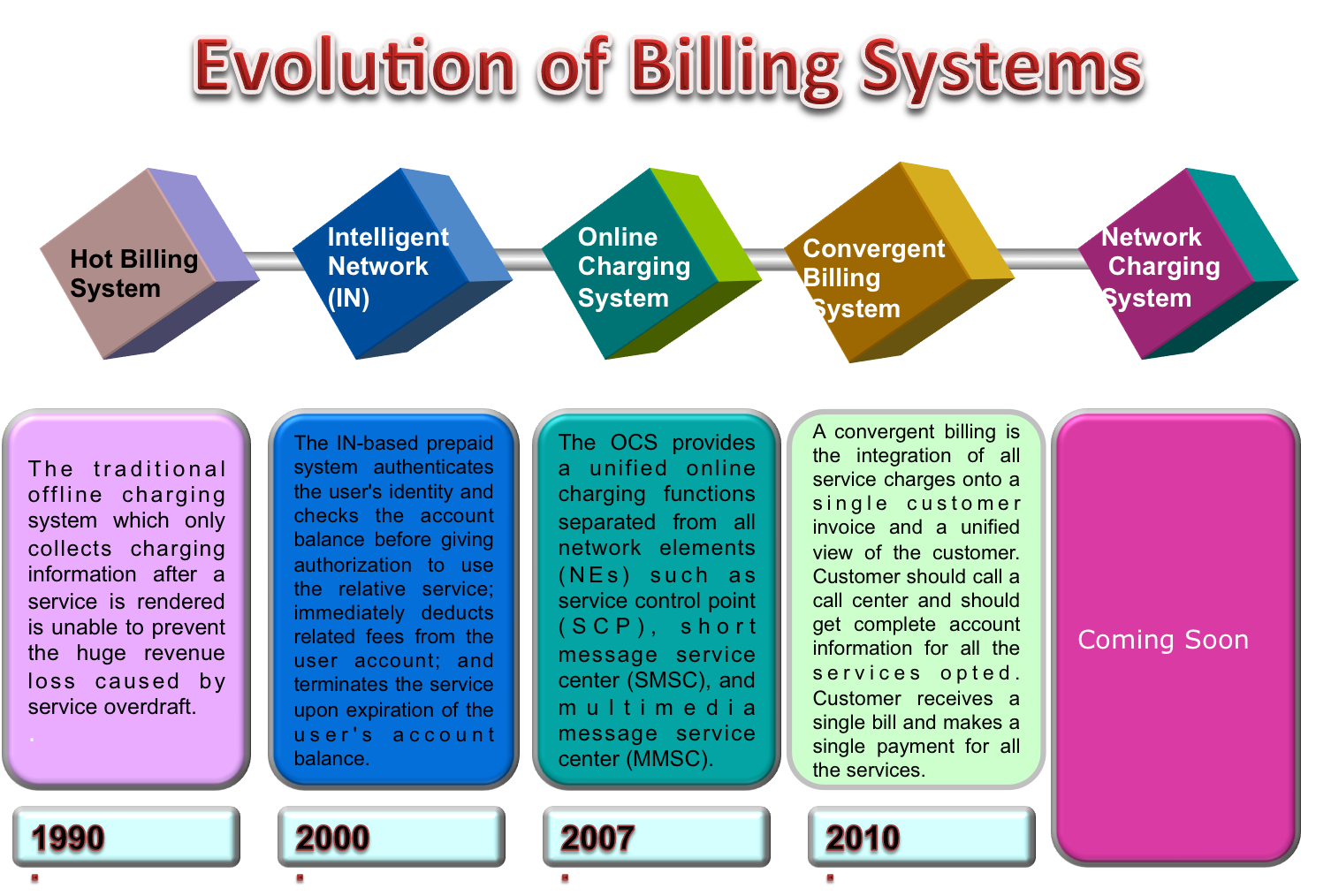
Telecom Billing & Charging: Billing systems started off with an archaic offline model that only allowed charging as an after-event, which resulted in severe revenue leakage.

These drawbacks led to the widespread utilization of intelligent networks, which performed balance checks before granting access to service and then carried out balance maintenance, terminating service upon depletion of the account balance. The increase in chargeable services gave rise to online charging systems, which separated charging capabilities from network capabilities. This empowered MNOs with revenue collection as well as service rollout efficiencies.
This post, Evolution: Telecom Billing and Charging, was originally published on February 26, 2015, on LinkedIn. This article is meant for discussion. Questions and answers are welcome.
Introduction
In today’s rapidly changing environment, service innovation and real-time capabilities are critical to maximizing revenue. Real-time convergent charging enables service innovation, allied to real-time control of debt exposure for more partner services and the ability to rate and bill on behalf of partners.

Online and offline charging are integral capabilities of any MNO or MVN. Prepaid services always require online charging for real-time service authorization, rating, and balance management. Postpaid services can use this online charging architecture for new service offerings. However, capitalizing on today’s tremendous opportunities can be challenging.
- Evolving Subscriber Demands: Telecom subscribers are becoming more sophisticated and demanding, pushing operators to innovate continuously.
- Expanding Services: Operators are integrating diverse services like mobile money, mobile banking, and mobile commerce to enhance the customer experience.
- Leveraging Infrastructure: The goal is to utilize existing investments and infrastructure to expand service offerings and attract new customers.
- Hybrid Billing Models: Combining traditional and modern billing approaches to provide flexible and convenient payment options.
- Innovative Distribution Channels: Real money transactions are now possible at roadside kiosks, reflecting the industry’s adaptability and responsiveness to market needs.
This requires true service excellence—the ability to provide a constant stream of new, innovative services supported by robust and excellent, completely modular systems with a short time to market. This allows for an almost real-time rollout of new services and perfect execution.
The Evolution of Billing Systems
The convergent system has centralized management of customer views, a hierarchically stored product catalogue, flexible customized pricing options, freely assorted sub- and primary accounts, and facilitates and assures marketing, customer care, and new business development.

OCS enables easy shifting between pre-paid and post-paid, flexible service bundles, and tariff packages aimed at different groups of customers that provide more promotion methods for the operators to exploit the market. This new generation of charging solutions greatly attracts customers through its distinguished and improved benefits and reduces the customer churn ratio, thus greatly enhancing customer loyalty and putting the telecom market’s expansion on the right track. The convergent and unified billing system enables customers to use all services at once, and the customized price bundle caters well to customer needs at different levels.
While convergence billing and the split OCS architecture tend to present many benefits to the operator, they could bring out complexities where the implementation of business rules can prove very difficult, i.e., you lose flexibility in case you give freebies (airtime, data, SMS, etc.). In converging billing systems, we have modules that take care of online charging (prepaid) and interconnect billing (batch/postpaid) as part of a single housing system, like the OCS system, and now there is a need to integrate a few more modules that can cater for mobile financial services, though 3GGP has not defined or endorsed anything yet for mobile financial services integration on OCS.
Convergent billing needs
By adopting both event-based charging and session-based charging, the OCS establishes a rational basis for service convergence. This satisfies the charging requirements of voice, data, and various levels of systems and applications. The system used for charging electric vehicles is evolving from the traditional postpaid BOSS or prepaid “IN” to a more sophisticated convergent billing structure. The foundation of this process is the OCS rating engine, supported by reference points to aid in rating engine deployment and meet the demands of new service development.

The crucial role of the convergent billing system lies in its ability to effectively organize and coordinate data, which ultimately results in the establishment of the most extensive customer database. The OCS utilizes effective methods for arranging billing information for each customer and service, as it plays a crucial role in managing the intricate data streams associated with online charging data. Multiple charging options exist, such as real-time charging for both postpaid and prepaid services as well as prepaid service charging, and these can be utilized in various combinations.
Online charging (based on the Ro and CAP interfaces) and offline charging (based on the Rf interface) describe the interaction between NEs and charging systems. Postpaid and prepaid indicate the interaction between account balance and user payment. As a result, user experience-based concepts—i.e., prepaid, postpaid, near real-time, and real-time—can be seamlessly mirrored to network-based concepts such as online and offline charging. Flexible maintenance and configuration through a web-based portal and support for multiple interfaces to external systems such as CRM, billing, etc. The bill-based, postpaid BOSS and independent prepaid IN charging systems are evolving into a convergent billing system

The OCS can develop by expanding itself in the context of account balance management. The OCS can also develop by integrating BOSS and IN, under which the OCS serves as a core for them both. These define shortcuts for the development of a convergent billing system. Data organized in this mode in the convergent billing system provides enhanced support for various customer types and user-oriented services.
Any Online Charging System with convergence should have the capability;
- Real-time charging.
- Data charging.
- Modular, robust and scalable architecture.
- Flexible & Configurable Tariffs & Services.

Conclusion : There’s no single answer to this without end-to-end architectural analysis. Let us open a discussion on this and build some intelligence around it. To date, the telecom industry has witnessed overwhelming success through commercial applications of the OCS. Operators from more than a dozen countries in Europe, Middle East, Asia Pacific and Africa are integrating the OCS in their networks, and increasingly more are welcoming the product Now its time to add other elements, which are crucial from future perspective, to give new shape and definition to convergence. This is my own thought process on the basis of reading from google and work experience from last decade or so.
====================== About the Author =================================
Read about the author at : About Me
Thank you all for spending your time reading this post. Please share your feedback, comments criticisms, agreements or disagreements. Remark: for more details about posts, subjects and relevance, please read the disclaimer.
FacebookPage Twitter ContactMe LinkedinPage ==========================================================================
