
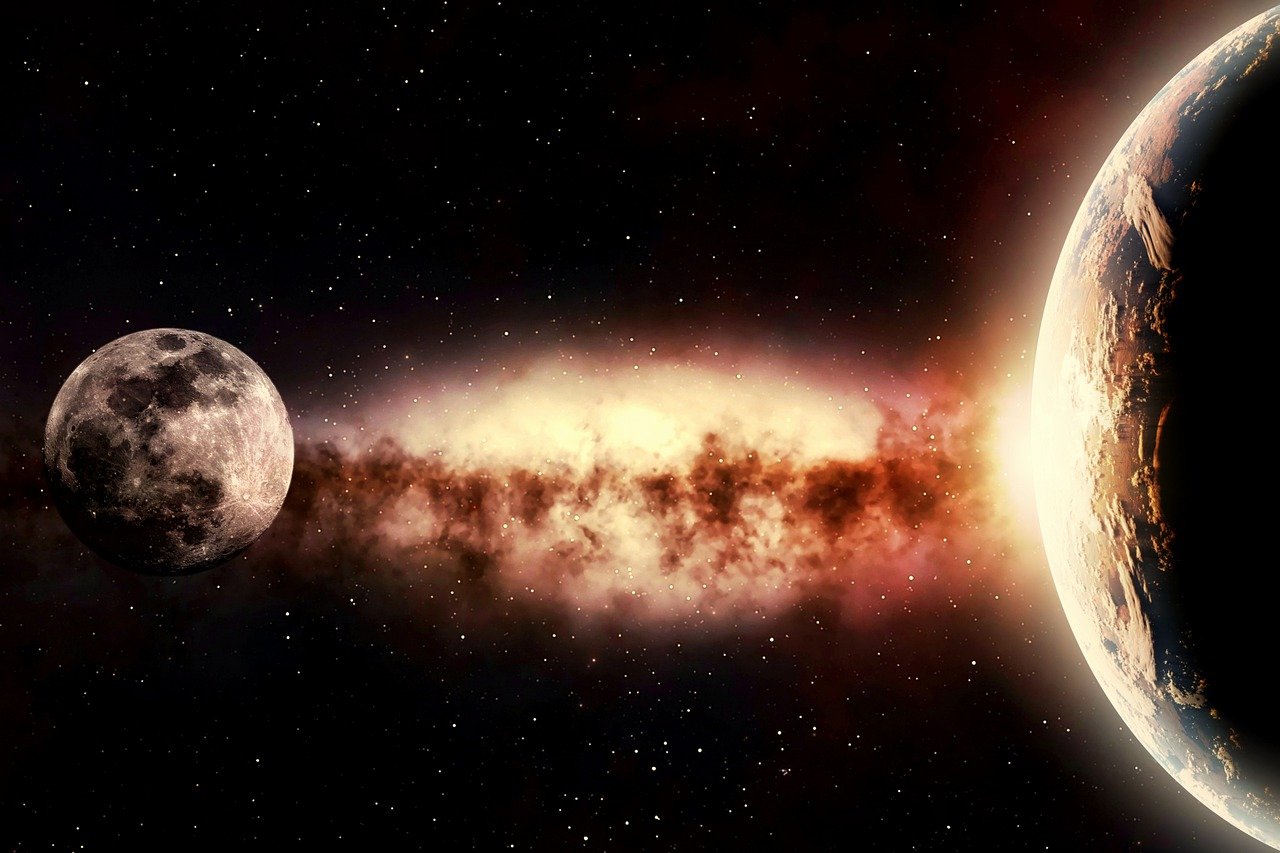
Dark Matter and Dark Energy – Both of them are mysterious and enigmatic components that comprise most of the universe’s mass-energy content.

Though both of them are invisible and enigmatic, they hold the cosmos in their gravitational and expansionary embrace, challenging our understanding of the universe. They have profound implications for our understanding of the cosmos, yet their exact nature remains one of the most significant unsolved mysteries in astrophysics and cosmology.
No, it has nothing to do with black magic, which is a myth. These cosmic enigmas beckon experts to delve deeper into the fundamental nature of space, matter, and the forces that shape the cosmos, pushing the boundaries of our cosmic comprehension. Despite decades of research, the true nature of Dark Matter remains a profound scientific puzzle, spurring ongoing experiments and investigations to unveil the secrets of this enigmatic cosmic component.
Dark Matter is a hypothetical form of matter that does not emit, absorb, or interact with electromagnetic radiation, such as light or radio waves. It is invisible and, as the name suggests, dark. Its existence is inferred from its gravitational effects on visible matter, galaxies, and the universe’s large-scale structure.
Dark Matter – Introduction
Dark Matter is a mysterious and invisible substance that constitutes a significant portion of the universe’s mass-energy content. It exerts a gravitational influence on galaxies and cosmic structures, shaping the cosmos as we know it. However, it does not interact with electromagnetic radiation, rendering it undetectable by traditional means. Its existence is inferred from its gravitational effects, such as galaxies’ rotational curves and the large-scale structure of the universe.

- Cold Dark Matter (CDM) – CDM is a widely accepted model that proposes dark matter particles move slowly compared to the speed of light. This slow movement allows dark matter to clump together, forming the gravitational scaffolding for galaxies and large-scale structures in the universe. CDM explains the distribution of galaxies and the formation of cosmic web structures.
- Warm Dark Matter (WDM) – WDM posits that dark matter particles have velocities between those of cold and hot dark matter. These particles move faster than those in the CDM model but slower than those in the HDM model. WDM aims to address some of the shortcomings of CDM, such as the overabundance of small-scale structures, by suggesting a smoother distribution of dark matter.
- Hot Dark Matter (HDM) – HDM suggests that dark matter particles move at relativistic speeds, close to the speed of light. Due to their high velocities, HDM particles cannot clump together easily, resulting in a more uniform distribution. While HDM was considered in early dark matter theories, it does not fully account for the observed structures in the universe and is less favored than CDM and WDM.
- Self-Interacting Dark Matter (SIDM) – SIDM introduces the idea that dark matter particles can interact with each other through forces other than gravity. These interactions could help explain the distribution of dark matter in galaxies, particularly in their cores. SIDM addresses some of the discrepancies observed in galactic structures that CDM does not fully explain.
In the vast cosmic expanse, a hidden force silently shapes the destiny of galaxies, stars, and the universe itself. This enigmatic cosmic ingredient, known as dark matter, has baffled experts and astronomers for generations, weaving an intricate tapestry of intrigue and mystery across the cosmos.
Some of the key points about Dark Matter:
- Gravitational Effects: Dark matter’s primary evidence is its gravitational influence on visible objects. Galaxies rotate at speeds that cannot be explained by visible matter alone. Dark matter’s gravitational pull helps explain this phenomenon.
- The Dark Matter Enigma: The story of Dark Matter begins with a peculiar cosmic conundrum: the visible matter in galaxies, such as stars, planets, and gas, does not account for the observed gravitational forces at work. Galaxies rotate too swiftly, and their structures are too massive to be solely influenced by the gravitational pull of visible matter. What is the missing piece of this celestial puzzle? Dark matter is a mysterious substance that eludes detection by conventional means, such as light or other forms of electromagnetic radiation.
- Composition Unknown: Despite extensive efforts, the exact nature of dark matter remains unknown. Various candidates, such as weakly interacting massive particles (WIMPs) and axes, have been proposed, but none have been definitively detected.
- Cosmic Abundance: Dark Matter is estimated to make up about 27% of the universe’s total mass-energy content, making it more abundant than ordinary matter (the stuff we can see and interact with), which comprises only about 5% of the universe.
- Clustering: Dark Matter plays a crucial role in the formation and evolution of large-scale cosmic structures, including galaxy clusters and the cosmic web.
- Experimental Searches: Experts are conducting experiments in underground laboratories and particle accelerators to detect Dark Matter particles directly or indirectly. So far, no conclusive evidence has been found.
As experts delve deeper into the mysteries of Dark Matter, they continue to push the boundaries of human knowledge and explore the fabric of the universe itself. With each discovery and experiment, we inch closer to understanding this cosmic enigma, unraveling the veil that shrouds one of the universe’s most enduring secrets. Dark Matter’s story is a testament to the unyielding curiosity of humanity, forever driven to seek answers to the most profound questions the cosmos has to offer.
Point of Attention – Saraswati Supercluster
In the grand tapestry of the cosmos, the Saraswati Supercluster stands out as a testament to the intricate and majestic structure of our universe. Identified in 2015, this colossal assembly of galaxy clusters stretches across the vastness of space, revealing the profound influence of dark matter.

- Discovery
- Identified in 2017 by a team led by Joydeep Bagchi and colleagues from the Inter-University Centre for Astronomy and Astrophysics (IUCAA) and the Indian Institute of Science Education and Research (IISER) in Pune, India.
- Reference: Discovery Details (IUCAA website)
- Size
- Spans approximately 652 million light-years in diameter, not 500 million light-years.
- Reference: Saraswati Supercluster Size (Science Daily)
- Distance from Earth
- Roughly 4 billion light-years away from Earth.
- Reference: Distance Information (Science Daily)
- Role of Dark Matter – Dark Matter Influence
- Dark matter is crucial in the formation and structure of the Saraswati Supercluster, influencing how galaxy clusters within it are bound together.
- Reference: Dark Matter Role (Science Daily)
- Light Travel Time
- Light takes approximately 1 billion years to travel from one end of the Saraswati Supercluster to the other, highlighting its immense scale.
- Reference: Light Travel Time (Science Daily)
- Scientific Impact
- Studying the Saraswati Supercluster provides valuable insights into the distribution of dark matter and the large-scale structure of the universe.
- Reference: Scientific Impact (IUCAA website)
The Saraswati Supercluster, a massive collection of galaxy clusters, exemplifies the influence of dark matter in cosmic structure formation. This write-up explores the distance light travels to cross the supercluster, its spatial relationships with various celestial bodies, and how these measurements enhance our understanding of dark matter and cosmic structures.
Laniakea Supercluster
The Laniakea Supercluster is a colossal cosmic structure that includes the Milky Way galaxy, which is home to Earth. Discovered in 2014 by a team led by Brent Tully from the University of Hawaii, Laniakea spans about 520 million light-years in diameter.
I live in Bangkok, so you can see the below hierarchy for the reference.
- Bangkok (City Level)
- Thailand (Country Level)
- Asia (Continent Level)
- Earth (Planet Level)
- Solar System (Star System Level)
- Milky Way Galaxy (Galactic Level)
- Local Group (Galactic Group Level)
- Virgo Supercluster (Supercluster Level)
- Laniakea Supercluster (Large Supercluster Level)
- Observable Universe (Universal Level)
- Location: Earth is situated within the Laniakea Supercluster. This supercluster encompasses our galaxy, the Milky Way.
- Size: The Laniakea Supercluster spans approximately 520 million light-years in diameter.
- Discovery: Identified in 2014 by a team led by Brent Tully from the University of Hawaii.
- Distance: The term “520 million light-years” refers to the span of the supercluster itself. Since Earth is located within it, this is not the distance from Earth to Laniakea but rather the size of the supercluster.
It provides a significant understanding of our position in the universe, revealing the vast scale and distribution of galaxies and dark matter.
Dark Energy
Dark Energy, a mysterious and dominant component of the universe, challenges our understanding of fundamental physics and cosmology. Unlike Dark Matter, which exerts gravitational attraction, Dark Energy manifests as a repulsive force. It’s responsible for the accelerated expansion of the universe, a discovery that reshaped our cosmic worldview in the late 1990s. While its exact nature remains an enigma,
Dark Energy is believed to make up approximately 68% of the universe’s mass-energy content. Its influence, driving galaxies apart and shaping the universe’s fate, continues to captivate experts, leading to ongoing research aimed at unravelling this profound cosmic mystery.

Dark Energy is an even more mysterious component of the universe. Unlike Dark Matter, which exerts a gravitational pull, Dark Energy is associated with a repulsive force that accelerates the expansion of the universe.
In the grand tapestry of the cosmos, there exists a pervasive, enigmatic force that defies our comprehension, captivating the minds of experts and astronomers for decades. This cosmic enigma, known as Dark Energy, stands as one of the most profound and perplexing mysteries in the realm of astrophysics and cosmology.
Some of the key points about Dark Energy:
- Accelerating Universe: Dark Energy was discovered in the late 1990s when astronomers observed that the expansion of the universe is not slowing down, as one might expect due to gravitational attraction, but is, in fact, accelerating.
- Unknown Origin: The origin and nature of Dark Energy are poorly understood. It is often described as a “cosmological constant” or “vacuum energy” associated with empty space. However, these descriptions raise more questions than answers.
- Dominant Component: Dark Energy is thought to comprise roughly 68% of the universe’s mass-energy content, making it the dominant component.
- Cosmic Fate: The nature of Dark Energy has profound implications for the fate of the universe. If its repulsive effect continues to dominate, it could lead to an ever-accelerating expansion, eventually resulting in a “Big Freeze” scenario.
- Theoretical Puzzles: Unraveling the nature of Dark Energy has proved to be an extraordinary challenge. The most straightforward explanation is a cosmological constant, a concept introduced by Albert Einstein in his equations of general relativity. However, this raises fundamental questions about why the constant has the observed value and what underlying physics governs it. Other theories propose evolving scalar fields or modifications to the laws of gravity.
- Ongoing Research: Research into Dark Energy is ongoing, with cosmologists using various techniques, including observations of distant supernovae and measurements of the cosmic microwave background radiation, to better understand its properties and effects.
Dark Energy stands as a testament to the boundless mysteries of the universe. Its role in propelling the cosmos into an accelerating expansion challenges our understanding of the fundamental forces and particles that govern the universe’s behavior. While it remains elusive, Dark Energy continues to beckon experts to venture into the unknown, illuminating the path toward a deeper comprehension of the cosmos and our place within it. In the grand odyssey of cosmic exploration.
Dark Energy remains a radiant beacon of discovery and wonder, inviting us to unlock the secrets of the universe’s most profound forces.
Point of Attention – The Great Attractor
In the quest to understand the fundamental forces shaping our universe, dark energy stands out as one of the most profound and enigmatic discoveries of modern cosmology. Unveiled in the late 1990s through observations of distant supernovae, dark energy is believed to drive the accelerated expansion of the universe.
One of the most intriguing manifestations of this phenomenon is the Great Attractor—a colossal gravitational anomaly that exerts a significant influence on the motion of galaxies and galaxy clusters across vast cosmic distances. The study of such structures provides crucial insights into how dark energy affects the large-scale dynamics of the universe.
- Introduction to the Great Attractor: The Great Attractor is a massive gravitational anomaly located approximately 150 million light-years from Earth. It is a significant region where the effects of dark energy are thought to play a crucial role in the cosmic structure.
- Influence on Galaxies: This mysterious region is responsible for the gravitational pull that affects the motion of galaxies and galaxy clusters within its vicinity, including our own Local Group. It offers insight into the influence of dark energy on large-scale cosmic flows.
- Distance and Scale: The Great Attractor spans a vast region of space, influencing an area approximately 200 million light-years across. Its sheer size and mass highlight the scale at which dark energy and gravity interact.
- Role in Cosmic Flow: The Great Attractor is part of a larger structure known as the Laniakea Supercluster, which is a supercluster of galaxies encompassing our own Milky Way. This highlights how dark energy influences the distribution and movement of cosmic structures.
- Ongoing Research: Studying the Great Attractor helps scientists understand the interplay between dark energy and gravity. Future observations and research, including those by the upcoming SKA (Square Kilometre Array) project, aim to further unravel the role of dark energy in shaping the universe’s structure.
The Great Attractor, located about 150 million light-years from Earth, is a massive region of space where the effects of dark energy are prominently observed. Spanning approximately 200 million light-years, it exerts a powerful gravitational pull that influences the movement of galaxies and clusters within its reach. As a key component of the Laniakea Supercluster, the Great Attractor helps scientists understand the interplay between dark energy and cosmic structures.
Research into this cosmic anomaly not only enhances our knowledge of dark energy but also sheds light on the broader dynamics governing the universe’s expansion and structure. Future investigations, particularly those involving advanced observational tools, aim to further explore the role of dark energy and refine our understanding of its impact on the cosmos.

Conclusion – Dark Matter and Dark Energy are two mysterious and elusive components of the universe that challenge our current understanding of cosmology and astrophysics. While Dark Matter’s gravitational effects are observable, its exact nature remains a mystery. Dark Energy, on the other hand, is even more enigmatic, driving the accelerated expansion of the universe, and its origins and properties are the subject of intense scientific investigation.
—
Point to Note:
All of my inspiration and sources come directly from the original works, and I make sure to give them complete credit. I am far from being knowledgeable in physics, and I am not even remotely close to being an expert or specialist in the field. I am a learner in the realm of theoretical physics.
======================= About the Author =======================
This post is authored by AILabPage from – Physics and Math Lab.

Physics and Math Lab by AILabPage is your ultimate hub for delving into the fascinating realms of Physics, Theoretical Physics, and Mathematics. Immerse yourself in an enriching experience where learning transcends mere understanding and becomes a thrilling journey of exploration. Through interactive sessions and hands-on experimentation, we unveil the intricate wonders of these disciplines. Join our dynamic community to explore the depths of theoretical concepts and mathematical principles. Follow us on Twitter and LinkedIn to stay informed about the latest advancements, discussions, and events. Remember, Math and Physics are fun, not a problem, so let’s learn and have fun together! Welcome to our realm of intellectually stimulating discovery!
Thank you all, for spending your time reading this post. Please share your opinions, comments, criticisms, agreements, or disagreements. Remark: For more details about posts, subjects, and relevance, please read the disclaimer.
============================================================

[…] Dark Matter and Dark Energy: Unlocking the Secrets of the Universe | Vinod Sharma’s Blog. https://vinodsblog.com/2020/09/15/dark-matter-and-dark-energy-unlocking-the-secrets-of-the-universe/ […]