
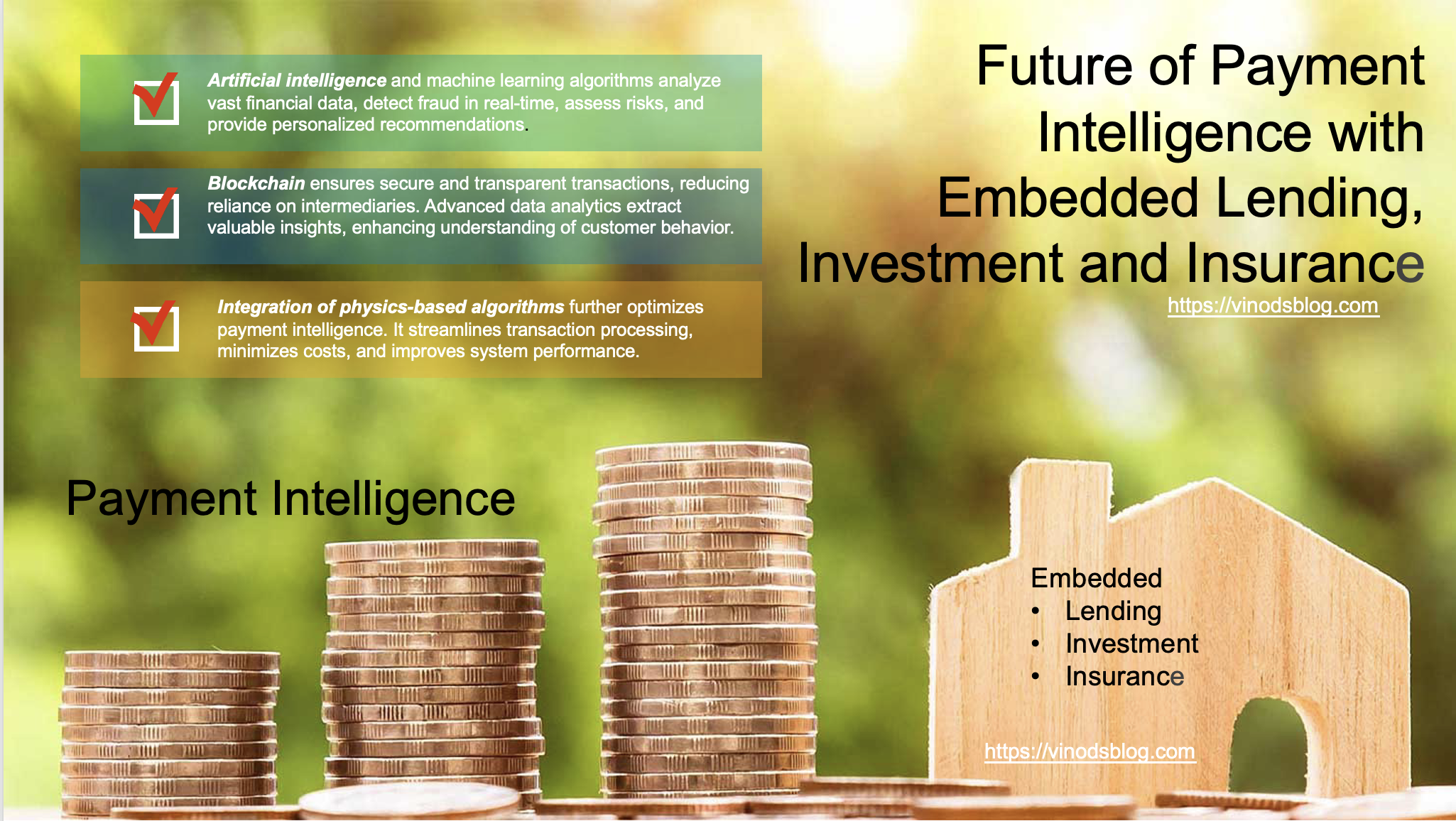
Future of PaymentIntelligence : The FinTech market has not seen any southward journey or downward trend since early 2011. It’s still bound to its northward journey, and in fact, it’s increasing its speed and spreading its wings or roots to the west and east as well.

The future of fintech is now accelerating at double speed after getting married to payment intelligence, became popular and understood firmly by Fintech of all sizes. Payment intelligence, which keeps artificial intelligence, machine learning, blockchain, physics, and advanced data analytics (including exploratory data analytics) at its core, has great potential and future with the integration of embedded lending, investment, and insurance.
As technology continues to advance and reshape the financial landscape, the convergence of these services within payment systems opens up new opportunities for individuals and businesses alike.This post is part 5 of PaymentIntelligence series , find part-4 here The Hidden Forces: Exploring Physics and Blockchain in PaymentIntelligence
Future of PaymentIntelligence (PI) – Outlook
When PaymentIntelligence gets combined with embedded lending, investment, and insurance services, it holds immense potential for reshaping the financial landscape and the way we handle money. This integration can transform how we make transactions, assess risks, and discover profitable investment options in the financial world. It opens up new possibilities for reshaping the way we manage our finances.

As depicted in the above picture, Fintech, giving new definition and perspective to payment intelligence. This fusion can unlock many hidden opportunities with much less cost, time, and effort. By keeping AI, ML, Blockchain, physics, and Data at its core to enhance its technological capabilities, FinTech can focus more on new and innovative ways of delivering legacy use cases, i.e., embedded lending, insurance, and investments.
By leveraging the capabilities of payment intelligence, individuals can experience seamless access to credit, personalized investment options, and tailored insurance coverage. This empowers them to navigate the financial realm with greater convenience, efficiency, and control.
Furthermore, the combination of payment information and financial services unfolds in a new era of convenience and Future of PaymentIntelligence. Consumers and FinTech’s can make better financial decisions by utilizing advanced data analysis and predictive modeling. This collaboration allows better understanding of what consumers want and like so that business can provide them with financial solutions that are properly tailored to their needs.
In the future, financial transactions will be better and more efficient (keeping CDBS aspect out for now). Control over finances will also be improved. With payment intelligence as the main focus, people and companies can expect smoother operations, less difficulties, and better adaptability. As technology keeps getting better, we will see more advanced tools being used in financial services. This will change how we use money and open up new opportunities in the financial industry.
Future of PaymentIntelligence – Technology Pack At Its Core
The rapid progress of technology has transformed the financial sector, leading to the fusion of services within payment systems. Payment intelligence, powered by advanced tools like artificial intelligence, machine learning, blockchain, data analytics, physics, and innovative algorithms at its core, has emerged as a formidable force to empower businesses and individuals. Through these cutting-edge tools, payment intelligence enables smarter financial decisions, enhances transaction security, and optimizes processes.
Lets look at these technologies one by one at the surface level
With the fusion of these tools, technologies, and techniques, Payment Intelligence streamlines financial operations, reduces friction and fraud, encourages higher spending, and delivers personalized experiences.

- Artificial intelligence and machine learning algorithms analyze vast financial data, detect fraud in real-time, assess risks, and provide personalized recommendations.
- Blockchain ensures secure and transparent transactions, reducing reliance on intermediaries. Advanced data analytics extract valuable insights, enhancing understanding of customer behavior.
- Integration of physics-based algorithms further optimizes payment intelligence. It streamlines transaction processing, minimizes costs, and improves system performance.
With all the above tools, technologies, and techniques at its core and in partnership with embedded lending, investments, and insurance, Payment Intelligence is transforming how we use and interact with money as the way we handle money evolves.
It simplifies borrowing money, offers customized investment options, and particularly builds insurance policies, bringing significant improvements to the financial industry. Payment intelligence employs innovative technologies to make transactions easier and more efficient and to provide businesses and individuals with greater financial control.
Partnership – PaymentIntelligence and Embedded Lending
The future of Payment Intelligence and Embedded lending is about integrating lending services directly into payment platforms, providing users with seamless, real-time access to credit. By embedding lending into payment systems, we enable instant, data-driven decisions that tailor credit options to individual needs.
- The need for separate loan applications is eliminated, streamlining the borrowing process.
- Payment intelligence systems analyze payment data and transaction history to assess creditworthiness.
- Personalized lending options are offered based on the analysis, allowing individuals and businesses to access funds quickly and efficiently.
- The integration of lending services into payment platforms revolutionizes the borrowing experience and enhances financial accessibility.
- Example
- If you are at the payment counter and your bill is $100 but you have only $80 in your wallet, the system can sense it and make an offer to you something like this: “Hey, I can help you. Here are two options: either take the $20 credit and return it in the next three months by paying $7.5 per month.
- Another way is where the system can fire a pull request from your family’s or friends’ wallets if you are on their white list to cover the gap.
This creates a frictionless experience where users can access loans as part of their everyday financial interactions, empowering them with smarter, faster, and more personalized financial solutions. It’s a future where technology meets finance to drive inclusion and accessibility for all.
Partnership – PaymentIntelligence and Embedded Investment
The partnership between Payment Intelligence and Embedded Investment empowers users to seamlessly invest directly from their payment accounts. By leveraging payment data and intelligent algorithms, we provide personalized investment options that truly resonate with individual needs. This integration also extends to embedded savings, allowing any money saved from offers to go straight into fixed-term savings, creating even greater value for consumers.

- Consumers can conveniently access investment opportunities and grow their wealth through this integration.
- Investing becomes more accessible, empowering individuals to participate in the financial markets.
- The integration of payment systems with investment features makes investing more convenient and user-friendly.
- This partnership enables individuals to build their financial futures by leveraging their payment accounts for investment purposes.
- Example i- When making a payment, if you get a 20% discount as a customer, you have the option to put the discounted money in savings to earn some interest on it. This way, consumers feel more happy to get more savings on money, which would have gone either way.
Our approach is all about making financial growth accessible and effortless, fostering a future where technology and finance work hand-in-hand for everyone’s benefit.
Investment Return Insights
Understanding investment returns is crucial in the fintech world. By calculating metrics like ROI, CAGR, and NPV, investors can make informed decisions that align with their financial goals and risk tolerance.
| Term | Full Form | Formula | Example | Definition | Application |
|---|---|---|---|---|---|
| ROI | Return on Investment | ROI = (Net Profit / Investment Cost) x 100 | If you invest $10,000 and make $12,000, ROI = (($12,000 – $10,000) / $10,000) x 100 = 20% | Measures the gain or loss on an investment relative to the amount of money invested. | Used to evaluate the profitability of an investment. |
| RRI | Real Rate of Return | RRI = [(1 + Nominal Rate) / (1 + Inflation Rate)] – 1 | If nominal return = 8% and inflation = 3%, RRI = [(1 + 0.08) / (1 + 0.03)] – 1 = 4.85% | Adjusts the nominal return by removing the effects of inflation to measure the true increase in purchasing power. | Helps assess the real profitability of an investment, considering inflation. |
| TWR | Time-Weighted Return | TWR = (1 + HPR1) * (1 + HPR2) * … * (1 + HPRn) – 1 | If portfolio returns are 5%, -2%, and 10%, TWR = (1 + 0.05) * (1 – 0.02) * (1 + 0.10) – 1 = 13.02% | Measures the compound rate of growth in a portfolio, eliminating the effects of cash inflows and outflows. | Used to compare portfolio performance without considering the investor’s deposit or withdrawal timing. |
| MWR | Money-Weighted Return | MWR involves solving for the IRR in the equation: | For an investment of $1,000, with a withdrawal of $500 after 1 year and a final value of $700, MWR is the IRR that solves: | Considers the size and timing of cash flows (deposits/withdrawals) to calculate the return on an investment. | Reflects an individual investor’s actual experience, taking into account the impact of contributions or withdrawals. |
| Initial Value + Cash Flows / (1 + MWR)^n = Final Value | $1,000 = $700 / (1 + MWR)^2, which yields an MWR of around 7% | ||||
| CAGR | Compound Annual Growth Rate | CAGR = [(Ending Value / Beginning Value) ^ (1 / # of Years)] – 1 | If an investment grows from $1,000 to $2,000 in 5 years, CAGR = [(2000 / 1000) ^ (1 / 5)] – 1 = 14.87% | Shows the mean annual growth rate of an investment over a specified period longer than one year, assuming reinvestment. | Used to evaluate the growth rate of investments over time and compare different investments. |
| ROE | Return on Equity | ROE = (Net Income / Shareholders’ Equity) x 100 | If a company makes a net income of $200,000 and has $1,000,000 in equity, ROE = ($200,000 / $1,000,000) x 100 = 20% | Measures the profitability of a company by comparing net income to shareholders’ equity. | Used to assess how efficiently a company is using shareholders’ equity to generate profits. |
| PV | Present Value | PV = FV / (1 + r)^n | If $1,000 is to be received in 5 years, at a discount rate of 5%, PV = 1000 / (1 + 0.05)^5 = $783.53 | The current value of a future sum of money, discounted at a specific interest rate. | Used to determine how much future cash flows are worth today. |
| FV | Future Value | FV = PV * (1 + r)^n | If $1,000 is invested today at an interest rate of 5% for 5 years, FV = 1000 * (1 + 0.05)^5 = $1,276.28 | The value of an investment or cash flow at a specific date in the future, based on a given interest rate. | Used to project the value of an investment over time, factoring in interest or growth. |
| NPV | Net Present Value | NPV = Σ [Cash Flow / (1 + r)^t] – Initial Investment | If an investment requires $10,000 and generates $3,000 for 5 years at a discount rate of 5%, NPV = $1,294.65 | The difference between the present value of cash inflows and the present value of cash outflows over a period of time. | Used to assess the profitability of an investment or project by comparing inflows to outflows in today’s terms. |
| NFV | Net Future Value | NFV = NPV * (1 + r)^n | If NPV = $1,294.65 and the time horizon is 5 years at a rate of 5%, NFV = $1,294.65 * (1 + 0.05)^5 = $1,652.89 | The future value of an investment after a series of cash inflows and outflows, assuming a certain interest rate or return. | Used to determine the future value of all cash flows from an investment, giving an overall future projection. |
Holding Period Return (HPR)
Definition:
Holding Period Return (HPR) is a measure used to calculate the total return on an investment over a specified period. It considers not only the appreciation (or depreciation) in the asset’s value but also any cash distributions (like dividends or interest payments) received during the holding period.
Formula:
The formula for HPR
HPR = [ (Ending Value − Beginning Value + Cash Distributions) / (Beginning Value) ] X 100
- Ending Value: The market value of the investment at the end of the holding period.
- Beginning Value: The market value of the investment at the start of the holding period.
- Cash Distributions: Any income received from the investment during the holding period, such as dividends or interest.
Example:
Imagine you purchased shares of a company for $1,000 (Beginning Value). After holding the shares for one year, the price of the shares has risen to $1,200 (Ending Value), and you received $50 in dividends during that year.
Plugging these values into the formula gives:
HPR = [ (1200 − 1000 + 50) / 1000 ] ×100 = (250 / 1000) ×100 = 25%
Interpretation:
A 25% HPR means that over the holding period, the investment has generated a total return of 25%, factoring in both price appreciation and dividend income. HPR is a useful metric for investors because it provides a simple way to assess the performance of an investment over time.
Key Points:
- Inclusive of All Returns: HPR accounts for both capital gains and income received, making it a comprehensive measure of investment performance.
- Time Frame Dependent: HPR is specific to the time period in which the investment is held, making it essential for comparing investments held over different durations.
- Comparison Tool: Investors can use HPR to compare the performance of different investments or assess the effectiveness of their investment strategy over time.
From ROI to NPV, these formulas offer insights into the performance of financial investments. Using them helps investors maximize returns, assess risks, and make strategic, long-term financial decisions.
Partnership – PaymentIntelligence and Embedded Insurance
The integration of Payment Intelligence and Embedded Insurance seamlessly weaves insurance services into payment systems, enhancing the user experience by providing added security and protection right at the point of transaction. This innovative approach ensures that users have peace of mind, knowing they are covered without having to navigate complex processes separately.
- Payment intelligence systems analyze transaction patterns to provide tailored insurance offerings.
- Insurance coverage can be automatically activated based on specific transactions, such as travel insurance when purchasing a flight ticket.
- Purchase protection insurance can be included for high-value items, providing users with peace of mind.
- This integration simplifies the insurance process, ensuring users have appropriate coverage when they need it most.
- Because you always have $50 as a minimum balance, the system asks for permission to lock that money and convert it into term insurance.
By embedding insurance directly into payment processes, we not only streamline transactions but also elevate the overall value of Payment Intelligence, positioning it as a leading contender in the evolving financial landscape. . This integration fosters a safer, more confident environment for users, empowering them to make informed financial decisions effortlessly.
PaymentsIntelligence – Present and Future of FinTech
Overall, the Future of PaymentIntelligence with embedded lending, investment, and insurance holds significant potential to revolutionize and boost the Fintech industry. By seamlessly integrating these services into payment systems, individuals and businesses can enjoy greater convenience, access to capital, investment opportunities, and financial protection.
- Advancing technology and sophisticated data analytics will make payment intelligence pivotal in shaping the future of financial transactions, granting individuals enhanced financial control and flexibility.
- The integration of payment intelligence enables us to leverage digital money more efficiently, ensuring safer, faster, and more convenient transactions.
- Payment intelligence harnesses new technologies and data to enhance the safety and security of payments.
- Banks and fintech companies are utilizing smart computer algorithms to offer tailored services that cater to specific markets and their unique requirements.
- This integration revolutionizes the payment landscape, driving innovation and meeting the evolving needs of consumers.
- The adoption of payment intelligence technologies strengthens financial systems, empowering individuals with advanced capabilities and a seamless payment experience.
African banks can grow a lot by following global rules, coming up with new ideas to succeed in the future, and gaining the trust of customers. Right now, many banks in Africa don’t have that trust.

Conclusion – In short Future of PaymentIntelligence is highly dependent upon The fusion of payments, physics, blockchain, and artificial intelligence, which is revolutionizing digital money usage. It enhances our understanding, safety, and efficiency, yielding impressive outcomes. This approach significantly advances digital payments by leveraging science and technology to improve security and efficiency. Through blockchain and AI, payment processes become simpler and more secure, ensuring transparency and tamper-proof transactions. Smart contracts further simplify transactions and unlock new opportunities for creative ideas across industries.
—
Feedback & Further Question
Do you need more details or have any questions on topics such as technology (including conventional architecture, machine learning, and deep learning), advanced data analysis (such as data science or big data), blockchain, theoretical physics, or photography? Please feel free to ask your question either by leaving a comment or by sending me an email. I will do my utmost to offer a response that meets your needs and expectations.
Points to Note:
it’s time to figure out when to use which tech—a tricky decision that can really only be tackled with a combination of experience and the type of problem in hand. So if you think you’ve got the right answer, take a bow and collect your credits! And don’t worry if you don’t get it right.
Books Referred & Other Material referred
- Self-Learning through Live Webinars, Conferences, Lectures, Seminars, Open Internet research, news portals and white papers reading
- Lab and hands-on experience of @AILabPage (Self-taught learners group) members.
============================ About the Author =======================
Read about Author at : About Me
Thank you all, for spending your time reading this post. Please share your opinion / comments / critics / agreements or disagreement. Remark for more details about posts, subjects and relevance please read the disclaimer.
FacebookPage ContactMe Twitter ====================================================================

Very innovatively and critically thought.Indeed the embedded payment is the way to broaden the core while creating a canopy of multiple access and solutions.
[…] NextFuture of PaymentIntelligence with Embedded Lending, Investment and […]
[…] Future of PaymentIntelligence with Embedded Lending, Investment and Insurance […]
[…] Domestic and Global Payments Inclusion (Merchants Driven Model): The payments landscape has been reshaped by Fintech, introducing seamless and inclusive solutions for both domestic and global transactions. From real-time payments to cross-border transfers, Fintech has enhanced the efficiency and accessibility of payment systems. […]
[…] Future of PaymentIntelligence with Embedded Lending, Investment and Insurance […]