
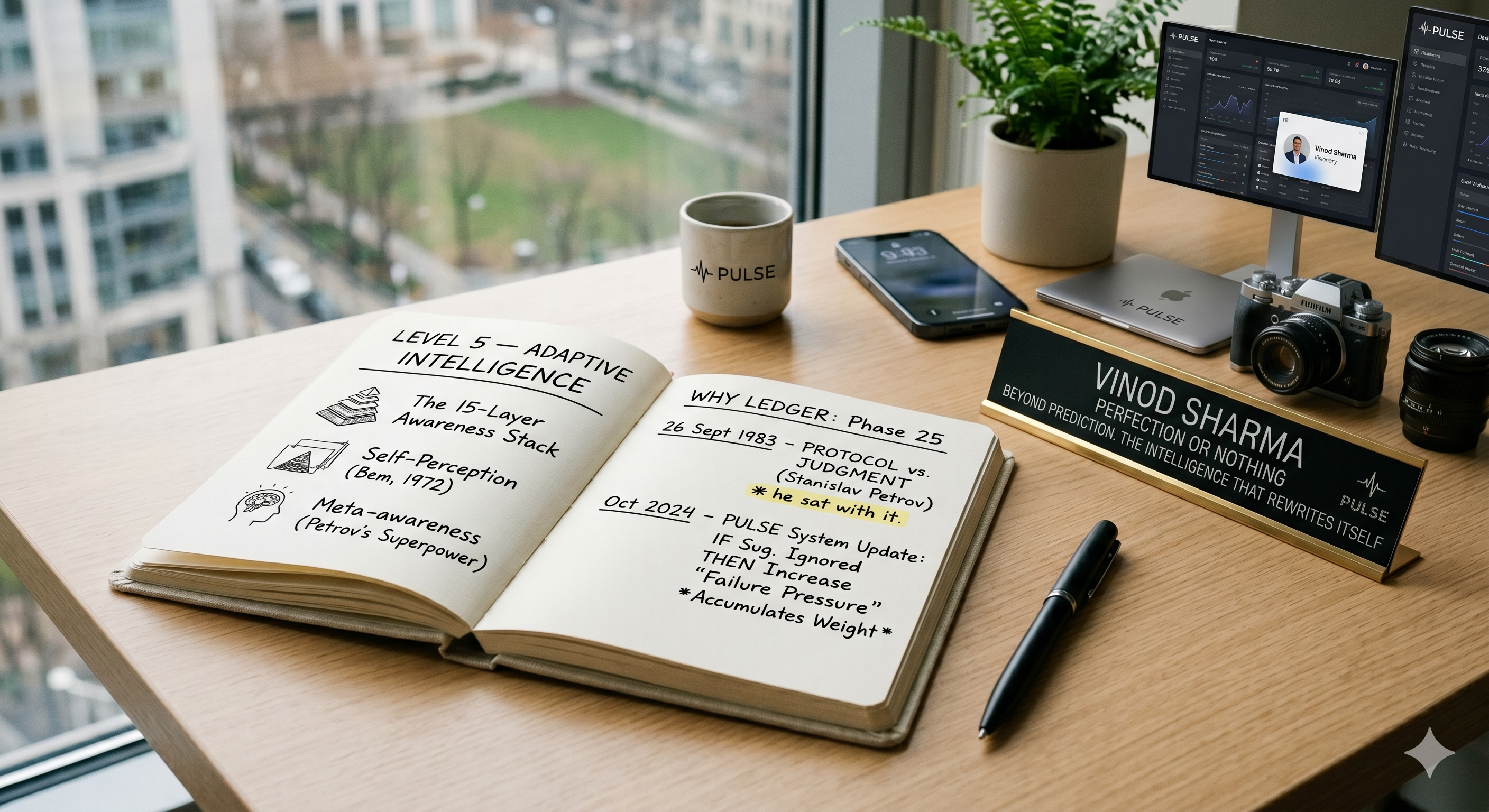
Intelligence– True intelligence isn’t the ability to predict — it’s the ability to rewrite yourself when reality disagrees with your prediction. Most people and most AI systems plateau not because they lack data, but because they can’t step outside the loop they’re running in.

This is an essay about meta-awareness: the fifth level of intelligence, where you don’t just react, recognise, learn, or predict — you notice yourself predicting, and change course. It’s what Soviet officer Stanislav Petrov did in 1983. It’s what most of us don’t do on Tuesday mornings. And it’s what I’ve been trying to build into Pulse for two years.
A quick note before we start: this isn’t an academic paper. It’s the long version of what I’ve been thinking about for the last two years, mostly at midnight, mostly on weekends, while building a system I call Pulse. I am not a neuroscientist. Not a psychologist. Not a doctor. Just someone who got deeply curious about why some people — and some systems — keep growing through their lives, and others quietly stop.
I went reading. What follows is what I found, in plain language, blended with what I’ve learned the hard way while trying to build a product that does this for real. The books and papers are listed at the bottom, in case any of it lands and you want to go deeper.
A Quiet Room, a Loud Screen, and One Man Who Paused
Just past midnight on September 26, 1983, a man named Stanislav Petrov — a lieutenant colonel in the Soviet Air Defence Forces — was the duty officer at a command bunker outside Moscow. His job that shift was to watch the screens of the Soviet early-warning satellite system. If those screens ever said the United States had launched nuclear missiles, he was to pick up the phone, report up the chain, and start the countdown to a Soviet counter-strike. That night, the screen lit up. Not once. Five times. Five American intercontinental missiles, the system said, inbound.

Everything in his training told him what to do next. The protocol was written. His hand was supposed to reach for the phone. And yet — he didn’t. He sat with it. He asked a question the system in front of him couldn’t ask: *if the United States were really starting the end of the world, why would they open with only five missiles?* A first strike is overwhelming — hundreds of warheads at once. Five felt wrong. Five felt like a glitch pretending to be a war.
He reported it as a malfunction. He was right. Weeks later, investigators traced the alarm to an unlikely alignment of sunlight bouncing off high-altitude clouds into the satellite’s sensors, which the software read as missile exhaust.
Billions of us are alive today, at least in part, because one person in one chair did something extraordinarily rare: he stepped outside the machine he was inside of — his training, his protocol, the alarm bells, the fear — and watched it from above for thirty seconds.
Researchers call that move **meta-awareness**: the ability to notice, in the moment, that a mental process is running inside you, and to look at it instead of being carried by it. From everything I’ve read, it’s the closest thing we have to a superpower. And the strange part is almost nobody is ever taught it. Not in school. Not at work. Not really even at home.
That’s what this essay is about. Why we almost never do what Petrov did. And what I’ve come to believe it takes to build that capacity — in a person, and in a piece of software.
The Loops We’re Living Inside Without Noticing
Most of us, most days, are not really “deciding” our lives. We’re running loops. The feeds we scroll, the people around us, the voices we inherited from childhood, the moods that rise and fall through the day — these things are steering more of us than we’d like to admit. The short way to say it: *you can’t see the machinery you’re inside of*. You can’t fix a program you don’t know is running.

The Three Loops That Stall Growth
| Loop | Core Mechanism | The Psychological Reality | The “Fake” Label |
| The Ego Loop | Treating feedback or critique as a personal attack rather than data. | Motivated Reasoning: The mind actively protects existing conclusions to keep the self from being “wrong.” | “Standing my ground” or “Confidence.” |
| The Fear Loop | Feeling the pain of potential loss twice as intensely as the joy of potential gain. | Loss Aversion: Turning down opportunities to avoid discomfort, regardless of the mathematical or logical benefit. | “Being careful” or “Prudence.” |
| The Habit Loop | Repeating actions in the same place and time every day without conscious choice. | Autopilot: Research shows ~43% of daily behavior is unconscious repetition, not active decision-making. | “My routine” or “Efficiency.” |
The thread: **you can’t interrupt a pattern you can’t see from the outside.** Most of us never get outside.
Three loops above in particular quietly eat lives. Not bad lives. Not unintelligent ones. Good, thoughtful, capable lives — including mine, and probably yours.
You’re Not Seeing Reality. You’re Guessing At It.
This is the part that genuinely rearranged my understanding of being a human — and, as it turns out, of what a thinking machine should look like too. For a long time, most of us were taught a simple model of perception: eyes take in the world, brain processes it, you “see” what’s there. Clean. Obvious. Wrong.
- The Brain is a Prediction Engine, Not a Camera: Your mind doesn’t passively record reality; it actively builds it. It generates a “best guess” of the world based on a lifetime of patterns, using your senses only to tweak the errors in its simulation.
- Experience is a “Controlled Hallucination”: As theorists Andy Clark and Karl Friston argue, what you see is a blend of internal expectations and external data. If your brain is certain a face should bulge outward, it will literally rewrite the light hitting your eyes to hide a hollow mask.
- Intelligence Often Serves Identity, Not Truth: High analytic “horsepower” doesn’t guarantee accuracy. Dan Kahan’s research proves that when facts threaten our political or social identity, we use our intelligence to defend our priors rather than update them—getting the math wrong on purpose to stay “right” in our tribe.
- Identity Overrides Reasoning: Logic is rarely the final judge. When a new fact conflicts with who we believe we are, reasoning fails. True intelligence isn’t just about processing power; it’s about the rare capacity to let the truth override the ego.
Once you really see that, you can’t un-see it. It explains almost every argument you’ve lost with someone who “should have known better.” It explains plenty of ones you’ve won for the wrong reasons. And if you’re honest, it explains a lot of the thinking you’ve done yourself. It certainly explains some of mine — and, importantly for what comes next, it explains why most software products fail to grow up. They predict well. They don’t know when they’re wrong.
The Fourth Level — Prediction — And Why It Isn’t Enough
Here’s where the essay and the late nights start talking to each other. For the last couple of years, most of my weekends and most of my midnights have gone into building what I think of as a 15-layer awareness stack for a product called Pulse.
The idea is simple to state and very hard to do: instead of a user opening an app and telling it what they need, the app reads the context — weather, inventory, sentiment, connectivity, financial headroom, time-of-day patterns, cultural and seasonal context, where you are and what mode you’re in, inflation shifts in your micro-region, cross-domain behavior — and composes all of it into a single weighted picture of the user’s Now. Then it offers the right thing, quietly, before being asked.
That’s not magic. That’s **Level 4: predictive intelligence**. It is, in a software sense, exactly the predictive brain from Part 3 — top-down priors meeting bottom-up signals, composing a best guess. It’s the difference between a calculator (you ask, it answers) and an assistant (it predicts, you confirm).
And here’s the thing nobody tells you when you’re building something like this: **predictive intelligence is a ceiling.** You can stack more layers. You can fuse them more cleverly. You can tune weights. You can ship. It will work — until it doesn’t. The ceiling is the same ceiling a person hits when their life runs entirely on priors: the system is very good at being confident, and it has no idea when it’s wrong.
A confidently wrong prediction is the most dangerous kind. Because nothing stops it. – This is exactly what happens to people at the peak of their careers who stop growing — they are predicting beautifully from a world that no longer exists. The priors still fire. The confidence still lands. The feedback, when it arrives, gets filtered out by the identity loop we talked about in Part 3. The system is predicting, but it’s not learning.
Which means the real question — for a life, and for a product — isn’t *how good is your prediction?* It’s *what happens when you’re wrong?*
The Fifth Level — Adaptive Intelligence, or: Learning to Feel Your Own Accuracy
The thing I’ve come to believe matters more than IQ, CQ, EQ, or raw predictive power — especially in a world changing faster than any of us can individually keep up with — is **adaptive intelligence**. Not how smart you are today. How *updateable* you are. How willing, and how able, you are to be a different person, or a different system, a year from now, if the evidence says you should be.
This is where the late nights in the lab meet the reality of being human. It’s the leap from a system that just “knows” things to one that actually “grows” from them.
The Architecture of Adaptation
| The Move | How it works in Pulse | How it works in Us |
| Failure Pressure | Weighting the Wrong: When a suggestion is ignored, the system feels “heavy.” It’s a numerical cost that forces the algorithm to realize it missed the mark. | The Cost of Error: If being wrong doesn’t sting a little, we never change. Growth requires us to feel the weight of our mistakes instead of just brushing them off as noise. |
| Sync Flow | Validating the Right: When a prediction lands perfectly, that specific logic path is reinforced. The system learns exactly why it succeeded in that moment. | Internalizing the Win: We need to “metabolize” our quiet victories—those moments when our gut was right—so they become a permanent part of our intuition. |
| The Why Ledger | Causal Rules: Every prediction carries an “IF-THEN” receipt. If it fails, the rule is benched; if it conflicts, a gate forces a resolution. Nothing is silently forgotten. | The Growth Record: We often change our minds and pretend we didn’t. A “Why Ledger”—or a journal—makes our evolving beliefs visible so we can’t gaslight ourselves. |
| The Mood Enum | The Xavi Monologue: The system narrates its state (Thriving vs. Critical). It’s not “feelings,” it’s legibility. A system failing in silence can’t be fixed. | Naming the State: Being able to say “I’m stressed and I’ve stopped learning” is a superpower. If you can’t name your mood, you can’t care for your own “operating system.” |
- From Prediction to Evolution: Phase 24 was about observing the user; Phase 25 is about the system observing itself. It’s the difference between an app that assists you and an intelligence that rewrites its own code based on the truth of your life.
- The Identity Filter: These four moves are designed to do one thing: bypass the ego. By giving failure weight and keeping a ledger of our “whys,” we stop defending who we were and start becoming who we need to be.
Underneath all four moves is one mechanism: they loosen the grip of the identity-protective filter from Part 3 — the one that otherwise turns perception, reasoning, and habit into a lifelong defense of the self you already are. Failure pressure makes being wrong cheap to admit. Sync flow makes being right cheap to notice.
The Why Ledger makes beliefs revisable without being destabilizing. The mood makes the whole thing audible to the operator. What do you think—does this capture the “Xavi” spirit while keeping the technical depth of the sprints?
Where This Leaves Us
None of this is a trick. There’s no shortcut. There isn’t a morning routine or an app. There’s only the slow, slightly embarrassing work of noticing your own loops, naming them out loud, letting failure have weight, letting success be metabolized, keeping a scrappy record of what you actually believed and why, and being able to say, plainly, how you’re doing — before someone has to ask.
I’ve learned more about this building the product than I ever did reading the books, and I’ve learned more reading the books than I ever would have building the product alone. The two conversations turned out to be the same conversation. What makes a person keep growing and what makes a system keep learning are, underneath, the same architecture.
Petrov is worth remembering, forty-odd years later, not because he was a hero in a uniform. Because for thirty seconds, under the worst pressure a human can be under, he did the thing the rest of us almost never do on an ordinary Tuesday: **he got outside of the machine he was inside of, and he looked at it.**
That is Level 5. That is adaptive intelligence. That is the work.
The quietly radical idea at the center of all of this: you are not obligated to be the same operating system a year from now that you are running today. You were never supposed to be. The refusal to update — that, I’ve come to believe, is the real failure of intelligence. Not being wrong. *Staying* wrong.
That question, asked often enough, changes lives. And, it turns out, it changes systems too. It’s the one Petrov asked. It’s the one I’m trying to teach a piece of software. It’s the one almost nobody else does.
## Frequently Asked Questions
**Q: What is adaptive intelligence?**
A: Adaptive intelligence is the capacity to update your beliefs and behavior when new evidence contradicts them — and to notice you’re doing it. It’s distinct from raw prediction: a weather model predicts; an adaptive system predicts, notices when it’s wrong, and changes its model. In humans, it shows up as the willingness to say “I was wrong” without defending the old view.
**Q: What’s the difference between prediction and learning?**
A: Prediction is producing an answer based on a model you already have. Learning is updating the model itself. A system that predicts well but can’t update is rigid — accurate today, obsolete tomorrow. A system that learns changes its assumptions when reality pushes back.
**Q: What is meta-awareness?**
A: Meta-awareness is the ability to observe your own thinking while you’re doing it — to notice “I’m about to react defensively” before you react. It’s the mechanism that lets you step outside a habit, a bias, or an ego loop. Without meta-awareness, prediction and habit run the show.
**Q: Who was Stanislav Petrov and why does he matter to AI?**
A: Stanislav Petrov was a Soviet lieutenant colonel who, on 26 September 1983, received a false alarm that the US had launched five nuclear missiles at the USSR. Protocol demanded retaliation. Petrov paused, reasoned that a real first strike wouldn’t be just five missiles, and reported it as a malfunction. He was right. He matters to AI because he chose meta-awareness over trained response — exactly what modern AI systems struggle to do.
**Q: What is predictive processing in the brain?**
A: Predictive processing, developed by Karl Friston and Andy Clark, argues that the brain isn’t primarily reacting to the world — it’s constantly predicting it, and only attending to the difference (the “prediction error”). You don’t see reality; you see your brain’s best guess, corrected in real time. It’s the neuroscience foundation for why we’re all running models, not facts.
**Q: Why do most people stop learning as they age?**
A: Not because of biology. Because the cost of updating beliefs goes up with age — your identity, career, and relationships are built on the old beliefs. Motivated reasoning and loss aversion make it easier to defend the old model than to rewrite it. The people who keep growing are the ones willing to pay that update cost.
**Q: How does this apply to AI systems and agents?**
A: AI systems plateau for the same reasons humans do: they optimise for the distribution they were trained on, and resist signals that demand re-architecting. Truly adaptive AI needs meta-level signals — not just loss functions, but the equivalent of a “why ledger” that tracks why past decisions failed, and changes policy, not just weights.
**Q: What is Pulse and how does it implement adaptive intelligence?**
A: Pulse is the system I’ve been building for two years. Its 15-layer awareness stack is designed so the system doesn’t just predict — it tracks its own prediction errors, logs them to a why ledger, and escalates when it detects it’s in a failure loop. The goal is an AI that notices when it’s wrong the way Petrov noticed the alarm was wrong.

Conclusion – Staring at those two screens, I realised they represent the heartbeat of a complete leader: one reflecting the strategic vision of the boardroom, the other pulsing with the raw, executable logic of the “Builder.” Strategy without execution is a hallucination, but execution without strategy is a drift.
By staying in the trenches—debugging microservices while directing roadmaps—I ensure that the “Electricity” we build for our users is never just a slide deck. True innovation isn’t found in the jargon of hyper-personalisation; it’s forged at 2:00 AM when the code finally breathes. Let’s stop talking and start building.
If you want a place to start, start here: next time something you believe gets challenged, don’t defend it. Don’t argue. Don’t go quiet and seethe. Ask one question, honestly — *if I were encountering this evidence fresh, without my name attached to the old position, what would I actually conclude?*
—
Points to Note
it’s time to figure out when to use which tech—a tricky decision that can really only be tackled with a combination of experience and the type of problem in hand. So if you think you’ve got the right answer, take a bow and collect your credits! And don’t worry if you don’t get it right.
Books + Other readings Referred
- Research AND READING i.e. , On the Petrov incident:* David Hoffman, *The Dead Hand* (2009).
- On the predictive brain:* Andy Clark, *Surfing Uncertainty* (2016); Anil Seth, *Being You* (2021). Karl Friston’s papers are the technical source, but dense — Clark and Seth
- On the hollow-face illusion:* the work of Richard Gregory.*On motivated reasoning:* Ziva Kunda’s 1990 paper, “The Case for Motivated Reasoning.”
- On loss aversion:* Daniel Kahneman, *Thinking, Fast and Slow* (2011).
- On habits:* Wendy Wood, *Good Habits, Bad Habits* (2019).
- On motivated numeracy:* Dan Kahan’s paper of that name.
- On self-perception theory:* Daryl Bem’s 1972 paper.
- Lab and hands-on experience of @AILabPage (Self-taught learners group) members.
Feedback & Further Question
Do you have any burning questions about Big Data, “AI & ML“, Blockchain, FinTech,Theoretical PhysicsPhotography or Fujifilm(SLRs or Lenses)? Please feel free to ask your question either by leaving a comment or by sending me an email. I will do my best to quench your curiosity.
=================== About the Author ===================
Read about Author at : About Me
Thank you all, for spending your time reading this post. Please share your feedback / comments / critics / agreements or disagreement. Remark for more details about posts, subjects and relevance please read the disclaimer.
FacebookPage ContactMe Twitter ========================================================
