
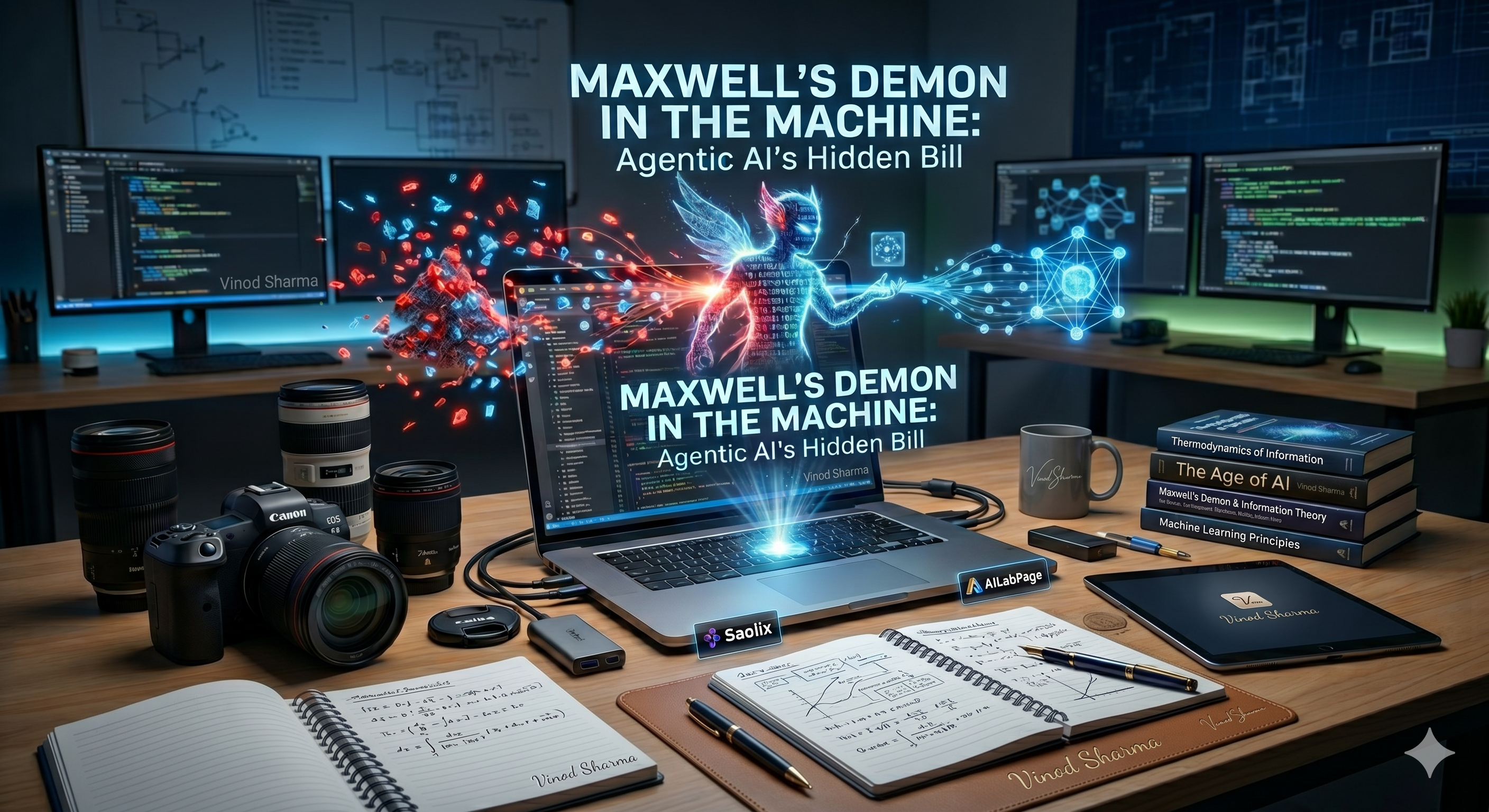
Maxwell’s Demon – What 19th-Century Physics Is Quietly Teaching Us About Agentic AI in Fintech. I have a habit that my team gently mocks me for. When I am stuck on a hard architectural decision, I don’t open a whiteboard, or a Miro board, or one of the seventeen tabs of vendor pitch decks sitting in my browser. I open a physics textbook.

This essay applies a 1961 insight from IBM physicist Rolf Landauer — that information has an unavoidable thermodynamic cost — to the current wave of agentic AI deployments in financial services, and proposes a framework I call the Landauer Principle for CTOs.
Not because I am trying to be clever. Because physics, unlike most things written about enterprise technology, tells the truth for free. And lately, as I watch boardroom after boardroom get sold the same glossy pitch about agentic AI transforming financial services, autonomous agents that will review loans, route payments, detect fraud, reconcile ledgers, approve transactions, all without human babysittin.
I keep coming back to a thought experiment written in 1867 by a Scottish physicist with extraordinary sideburns.
His name was James Clerk Maxwell. The creature he imagined is called Maxwell’s Demon. And the longer I work in this industry, the more convinced I am that every CTO, CIO, and chief risk officer in fintech needs to meet it — preferably before they sign their next agentic AI contract.
The Demon That Shouldn’t Exist
The Second Law of Thermodynamics is one of the most reliable statements ever made about the universe. In plain English: things tend toward disorder. Heat flows from hot to cold. Ice cubes melt; melted water does not spontaneously refreeze itself. Entropy — the technical name for disorder — only ever increases in a closed system. Full stop.
In 1867, Maxwell asked a mischievous question. What if you had a tiny, intelligent being — a “demon,” though he didn’t love the label — standing at a trapdoor between two chambers of gas? This demon watches individual molecules fly around. When a fast one approaches from the left, the demon opens the door and lets it through to the right. When a slow one approaches from the right, the demon opens the door and lets it through to the left.
The result? Slowly, elegantly, with seemingly no energy input, one side gets hot and the other gets cold. Order emerges from chaos. The Second Law appears to have been broken by a clever observer with good reflexes.
Physicists lost sleep over this for nearly a century.
The Bill Nobody Expected
In 1961, an IBM researcher named Rolf Landauer finally delivered the answer, and it is one of the quietly most profound results in modern science.
Information itself has a thermodynamic cost.
Specifically, the erasure of one bit of information requires a minimum amount of energy dissipated as heat — roughly 2.85 zeptojoules at room temperature. It is a tiny number, but it is not zero. And it is unavoidable.
Maxwell’s Demon, it turns out, cannot work for free. To sort molecules, it must measure them. To measure, it must store the result in some kind of memory. And eventually, to keep working, it must erase old memories to make room for new ones. That erasure is where the Second Law collects its debt. The demon doesn’t violate thermodynamics. It hides its energy costs inside the act of computation itself.
This is the punchline I want you to hold onto:
Intelligence that appears to create order from chaos is always, always, always paying an energy bill somewhere. If you can’t see the bill, you aren’t looking hard enough.
Now let me tell you why this matters for your fintech stack.
The Agentic AI Pitch, Read Carefully
Spend any time in fintech leadership circles in 2026 and you have heard some version of this pitch:
“Our agentic AI platform autonomously handles transaction monitoring, fraud detection, KYC escalation, reconciliation, dispute resolution, and customer service triage. It learns continuously. It makes decisions at machine speed. It scales without adding headcount. It is, essentially, a tireless team of digital analysts that never sleep, never quit, and never ask for a raise.”
Read that pitch again, carefully. Now read Maxwell’s 1867 description of his demon.
They are the same pitch.
An agent that observes a messy, high-entropy environment — thousands of transactions per second, all different, all noisy — and sorts them into neat, ordered outcomes (approve, deny, escalate, investigate) with apparently zero marginal cost. Order from chaos, created by an intelligent observer at a gate.
It sounds magical. And just like Maxwell’s Demon, it is not actually free. The energy bill is real. It is just hidden.
Where the Entropy Bill Shows Up in Real Fintech Systems
Having worked across African and emerging-market fintech for longer than I care to admit on a public blog, I can tell you exactly where the hidden costs of agentic AI show up. They don’t appear on the vendor’s invoice. They appear in your operating model, six to eighteen months after deployment, and by then the executives who signed the contract have usually moved to another company.
Here is the ledger I wish every board would ask for before approving an agentic AI deployment:
| What the pitch deck promised | Where the entropy bill actually arrives |
|---|---|
| “Autonomous fraud detection — zero human review” | Model drift on new fraud patterns; retraining cycles; false-positive storms that bury your ops team |
| “Instant loan decisioning at scale” | Explainability debt; regulator questions you cannot answer; adverse-action notices that cannot be legally defended |
| “Self-healing reconciliation” | Silent failures; reconciliations that look complete but miss edge cases; audit surprises at year-end |
| “Multi-agent orchestration of back-office” | Context loss between agent handoffs; duplicated work; agents disagreeing with each other in production |
| “Continuous learning — gets smarter every day” | Data poisoning risk; feedback loops that amplify bias; performance that degrades silently until a regulator or a customer catches it |
| “Reduces operational headcount by 40%” | New specialist roles nobody budgeted for: prompt engineers, evaluation leads, agent SREs, governance officers |
Notice something important: I am not saying agentic AI doesn’t work. It does — brilliantly, in the right places. I am saying it does not work for free. The question is never “should we deploy agentic AI?” — it is “are we honest about where the costs will land, and have we budgeted for them with the same seriousness as we budgeted for the licence fees?”
The Landauer Principle for CTOs
Let me propose a mental model. I call it the Landauer Principle for CTOs, and I use it every time a vendor walks into my office with a deck that has the word autonomous on more than three slides.
Every bit of order that an intelligent system creates in your operations is paid for somewhere. Your job is to find out where, measure it honestly, and make sure the payer is someone you are willing to be. This reframes the conversation in three useful ways.
First, it forces honest accounting
An agent that “reduces manual reviews by 80%” is not free. It is shifting the work — and the risk — to a different part of your system. That might be a new monitoring function, a new governance committee, a new class of incidents, or a new tail-risk exposure that only shows up once every few thousand transactions. You need to find it., need to name it and need to budget for it.
Second, it forces architectural honesty
Agentic systems that operate without any form of human checkpoint are not sophisticated. They are lossy. They have offloaded so much measurement and memory overhead that they have lost the ability to explain their own behaviour. That is a problem in any domain. In regulated financial services, it is a career-ending problem waiting for a calendar entry.
Third, it forces strategic humility
Not every process deserves to be agentised. The highest-value use cases are usually the ones where the entropy bill is smallest and most predictable — not the ones where it is most dramatic.
The Three Questions of Thermodynamic Honesty
When my team evaluates a potential agentic AI deployment now, we run it through what I have started calling the Three Questions of Thermodynamic Honesty. They are deliberately simple, because the sophisticated questions are the ones people dodge.
- Where is the entropy going? If our system is creating order — routing, sorting, deciding, reconciling — where is the corresponding disorder being pushed? Into monitoring overhead? Into governance complexity? Into tail risk? Into a new operational team we haven’t hired yet?
- Who pays the bill when it arrives? The vendor won’t. The model won’t. The executive who signed the contract may have moved on. Is it our ops team? Our compliance function? Our customers, through worse outcomes they cannot diagnose? Our regulator, through questions we cannot answer?
- Can we measure the bill in real time? A hidden cost you can measure is a manageable cost. A hidden cost you cannot measure is a future crisis. If we cannot instrument the entropy — model drift, decision quality, explanation coverage, edge-case behaviour — we have not really deployed an agentic system. We have deployed a ticking clock.
Teams that take these three questions seriously build very different systems than teams that don’t. Theirs are slower to launch, less glamorous in the all-hands deck, and — this is the part nobody writes about — dramatically more likely to still be in production two years later, doing what they were supposed to do.
A Quick Field Guide: Where Agentic AI Earns Its Entropy Bill, and Where It Doesn’t
Not every fintech use case is a Maxwell’s Demon waiting to overheat. Some are genuinely well-matched to agentic approaches, and it helps to be specific about which.
| Use case | Agentic fit | Why |
|---|---|---|
| Internal ops automation (routing tickets, drafting responses, summarising cases) | High | Low-stakes, reversible, easy to instrument, humans stay in the loop by default |
| Customer onboarding triage & document pre-screening | Medium–High | Clear success metrics, bounded scope, human handoff is natural |
| Fraud investigation support for analysts | Medium–High | Augments human judgement; the analyst owns the decision |
| Fully autonomous fraud blocking at scale | Low–Medium | Tail-risk exposure is enormous; explainability is non-negotiable; regulators will ask |
| Autonomous credit decisioning without human sign-off | Low | Adverse-action requirements, fair-lending exposure, and drift risk combine to a bad outcome |
| Multi-agent orchestration of core financial posting & settlement | Very Low | The entropy cost of a silent failure here is existential; determinism earns its price |
You can feel the physics in the table. The further down the list you go, the higher the temperature differential the demon is trying to create — and the bigger the bill Landauer is going to present when it arrives.
What This Means for the Next Two Years
We are, right now, in the most hyped phase of agentic AI adoption that financial services has ever experienced. Budgets are being approved on the basis of demos. Strategies are being written on the basis of analyst reports. Careers are being built on the basis of pilot projects that have not yet survived a full regulatory audit cycle.
I am not a pessimist about any of this. I genuinely believe agentic AI will transform how financial services operate — particularly for emerging markets, where the legacy infrastructure gap creates space for leapfrog deployment that richer markets cannot match. I have bet my career on that belief, more than once.
But I am a physicist at heart, before I am a technologist. And physics tells me, in its patient, unbending way, that there is no such thing as a free lunch. There never has been. There never will be.
Every CTO, CIO, and chief risk officer in fintech right now has a choice. You can believe the demon at the trapdoor is magic, and build your strategy accordingly — and pay the entropy bill when it arrives, which it will, probably on a Monday morning, probably from a regulator. Or you can look for the bill now, while you still have time to budget for it, instrument it, and design around it.
The leaders who do the second thing will look, in five years, like they had a gift for seeing around corners. They didn’t. They just took Maxwell seriously.
Entropy doesn’t wait for anyone’s content calendar either.
## Frequently Asked Questions
**Q: What is Maxwell’s Demon and how does it relate to AI?**
A: Maxwell’s Demon is an 1867 thought experiment by Scottish physicist James Clerk Maxwell: an intelligent being at a trapdoor between two gas chambers, sorting fast molecules from slow ones, appears to create order from chaos without energy input — seemingly violating the Second Law of Thermodynamics. It relates to AI because agentic AI systems are pitched the same way: intelligent observers that sort noisy transactions into ordered outcomes at apparently zero cost. Both are illusions that hide their real cost elsewhere.
**Q: What is the Landauer Principle and why does it matter for AI?**
A: The Landauer Principle, proposed by IBM physicist Rolf Landauer in 1961, states that erasing one bit of information requires a minimum energy dissipation of about 2.85 zeptojoules at room temperature. It resolved the Maxwell’s Demon paradox by showing that intelligence has an unavoidable thermodynamic cost — in computation, memory, or operational overhead. For AI, it means that “autonomous” systems don’t eliminate cost; they shift it to measurement, monitoring, governance, and tail risk.
**Q: What is the Landauer Principle for CTOs?**
A: It’s a mental model I propose in this post: every bit of order an intelligent system creates in your operations is paid for somewhere. A CTO’s job is to find out where the cost lands, measure it honestly, and make sure the payer is someone you’re willing to be. It reframes agentic AI evaluation from “will it work?” to “where will the bill arrive, and who will pay it?”
**Q: Where does the hidden cost of agentic AI actually show up in fintech?**
A: Six to eighteen months after deployment, typically in: model drift on new patterns, false-positive storms, explainability debt that regulators flag, silent reconciliation failures, context loss between agent handoffs, feedback loops amplifying bias, and new specialist roles (prompt engineers, agent SREs, evaluation leads, governance officers) that were not in the original budget.
**Q: What are the Three Questions of Thermodynamic Honesty for agentic AI?**
A: Before deploying agentic AI, leadership should answer: (1) Where is the entropy going? If the system creates order, where is the corresponding disorder being pushed? (2) Who pays the bill when it arrives — ops, compliance, customers, regulators? (3) Can we measure the bill in real time? A hidden cost you can measure is manageable; one you cannot is a future crisis.
**Q: Which fintech use cases are actually well-matched to agentic AI?**
A: High-fit: internal ops automation (ticket routing, case summarisation), customer onboarding triage, fraud investigation support for human analysts. Low-fit: fully autonomous fraud blocking, autonomous credit decisioning without human sign-off, multi-agent orchestration of core financial posting and settlement — where silent failure is existential and regulators require explainability.
**Q: Does this mean agentic AI is not worth deploying?**
A: No. Agentic AI will transform financial services, especially in emerging markets with leapfrog opportunities. The argument is not against agentic AI, but against dishonest accounting of its costs. Teams that budget for the entropy bill — instrument it, govern it, design around it — are dramatically more likely to have agentic systems still in production two years after launch.
**Q: What is the Second Law of Thermodynamics in plain English?**
A: Things tend toward disorder. Heat flows from hot to cold. Order doesn’t spontaneously emerge in a closed system. Entropy — the technical name for disorder — only ever increases unless energy is expended. It’s one of the most reliable statements ever made about the physical world, and it applies to information systems as much as to gases.

Conclusion – If you are a founder, an engineer, a product lead, a compliance officer, or a technologist of any stripe working on agentic systems in financial services — and especially if you are doing it in an emerging market, where the stakes and the leverage are both unusually high — I want to say something genuine to you.
The people who will define the next decade of fintech are not the ones who shouted the loudest about AI in 2026. They are the ones who quietly understood that intelligence has a cost, order has a price, and the most important skill in technology leadership is being honest about trade-offs that the rest of the industry is pretending don’t exist.
That honesty is available to everyone in this field. It doesn’t require a physics PhD or a Silicon Valley postcode. It requires the discipline to ask, every time, where is the bill, and who is going to pay it? Maxwell’s Demon is not a warning against ambition. It is a standing invitation to be a slightly better engineer than the moment requires. That invitation is open to all of us. And the clock — thermodynamically speaking — is always, always running.
—
Points to Note:
We have covered all basics around mobile payment security and the importance of mobile payment data. AI is becoming a classifier instrument to put banks in good and best bank category. So banks that want to jump to the best category are jumping to adopt AI, BOTS and machine learning techniques. This is possible only after banks can utilise and understand the data they have. Data to serve and understand customers etc. All credits if any remains on the original contributor only.
Books + Other readings Referred
- Research through open internet, news portals, white papers, notes made at knowledge sharing sessions and from live conferences & lectures.
- Lab and hands-on experience of @AILabPage (Self-taught learners group) members.
- “James Clerk Maxwell” https://en.wikipedia.org/wiki/James_Clerk_Maxwell
- “Maxwell’s Demon” https://en.wikipedia.org/wiki/Maxwell%27s_demon
- “Rolf Landauer” https://en.wikipedia.org/wiki/Rolf_Landauer
- “Landauer’s principle” https://en.wikipedia.org/wiki/Landauer%27s_principle
- “Second Law of Thermodynamics” https://en.wikipedia.org/wiki/Second_law_of_thermodynamics
- “2.85 zeptojoules at room temperature” https://en.wikipedia.org/wiki/Landauer%27s_principle#Derivation
Feedback & Further Question
Do you have any questions about AI, Machine Learning, Data billing/charging, Data Science or Big Data Analytics? Leave a question in a comment section or ask via email. I w
====================== About the Author ================================
Read about Author at: About Me
Thank you all, for spending your time reading this post. Please share your feedback / comments / critics / agreements or disagreement. Remark for more details about posts, subjects, and relevance please read the disclaimer.
FacebookPageTwitter ContactMe LinkedinPage ==========================================================================

Maxwell’s demon is an entity in a 150-year-old thought experiment that paradoxically appears to violate the second law of thermodynamics by reducing entropy without doing work. It has increasingly practical implications as advances in nanomachinery produce devices that push the thermodynamic limits imposed by the second law.
For most of the century and a half since Maxwell first proposed the thought experiment an entity that could sort molecules on the molecular scale was beyond the reach of technology, and Maxwell’s demon stood primarily as an abstract conceptual tool for understanding the statistical foundations of thermodynamics. In recent years, though, advances in nanotechnology have brought molecular machines into the realm of possibility, and devices approximating the function of Maxwell’s demon have now been made…..
Good post! We will be linking to this particularly great post on our site. Keep up the great writing
Thanks for sharing. I read many of your blog posts, and this one stands out for its strategic humility. Your field guide on agentic fit is incredibly practical, especially warning against fully autonomous credit decisions or core ledger orchestrations. Your blog is very good at exposing trade-offs that the rest of the industry tries to ignore. Looking forward to your next update!