
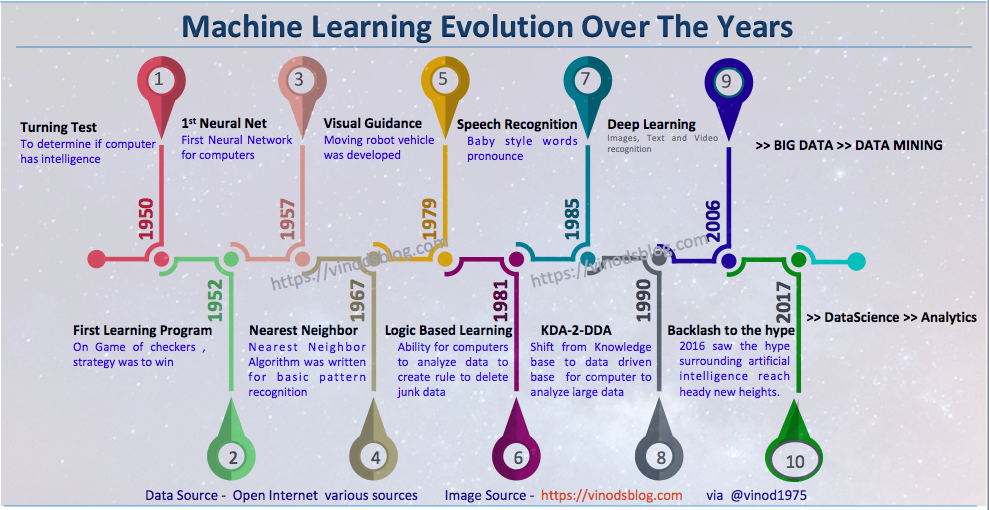
Machine Learning – ML for businesses, particularly those that specialise in generating vast amounts of data, like social media platforms, this opportunity may appear to be extremely lucrative.

Regrettably, the present iteration of machine learning in industrial applications is exceedingly restricted and solely designated for accomplishing mundane duties. What is significantly lacking in the business world is the ability to fully comprehend, illustrate, derive genuine benefits, and effectively utilize these commonly used terms, which requires immediate attention.
There is a gap between understanding the theory and applying it in ways that truly transform processes and outcomes. As someone who has seen both the potential and limitations firsthand, I feel this disconnect needs urgent focus. In this blog post, I am attempting to create a short text movie of machine learning timelines to give a high-level view of machine learning evolution, reflecting how it has developed, its current state, and where it’s heading next.
In machine learning, overfitting can occur even in small datasets, where models tend to “memorize” data instead of generalizing, leading to poor performance on unseen data. Additionally, some neural networks have been found to memorize specific data points, challenging the common assumption that models always generalize well. Interestingly, certain neurons in deep learning models can become highly specialized, sometimes leading to unexpected behaviors that defy typical training patterns.
For Basics around Machine Learning please read this.
Machine Learning(ML) – Introduction to Basics
Setting the Stage: Understanding Machine Learning
Machine learning represents a paradigm shift in how technology evolves and adapts. ML has transformed from a niche concept to a critical pillar of modern innovation by enabling systems to learn and improve from data without being explicitly programmed. Understanding its foundational principles is essential to unlocking its potential.

- Importance of Data: High-quality, structured data is the backbone of ML, empowering algorithms to learn, adapt, and improve over time.
- Applications and Impact: From personalized recommendations to advanced medical diagnoses, ML is driving innovation across industries, creating smarter, more efficient systems.
| Section | Description | Key Takeaways | Examples/Applications |
|---|---|---|---|
| What is Machine Learning? | Machine learning (ML) is a subset of artificial intelligence that enables systems to learn and improve from experience without explicit programming. | ML focuses on algorithms that process data to make predictions or decisions. | Spam detection, product recommendations, fraud detection |
| The Evolution of Machine Learning | ML has evolved from basic rule-based systems to modern AI, capable of complex decision-making. Early systems relied on pre-defined rules, while today’s ML adapts dynamically to data. | The shift from static rules to adaptable systems has made ML more efficient and versatile. | Voice assistants, autonomous vehicles |
| Key Concepts in Machine Learning | Fundamental concepts include models (the logic for predictions), features (input variables), labels (output variables), and predictions (results). | Understanding these elements is crucial to grasping how ML systems function. | Features: Age, income; Labels: Approved or rejected loans |
| The Role of Data in Machine Learning | Data is the foundation of ML. It trains algorithms, helps refine models, and ensures accurate predictions. Clean, well-structured data is essential. | The quality and quantity of data directly impact an ML system’s success. | Customer segmentation, sales forecasting |
| What are Machine Learning Algorithms? | ML algorithms are sets of instructions that allow computers to learn patterns from data. These include decision trees, neural networks, and clustering methods. | Algorithms process raw data into actionable insights, driving predictions and classifications. | Image recognition, stock price predictions |
| Why Are ML Algorithms Considered Powerful? | ML algorithms can process vast amounts of data, uncover hidden patterns, adapt to changes, and solve complex problems efficiently. | Their ability to handle real-time and large-scale data applications makes them invaluable. | Predictive maintenance, dynamic pricing |
| The Growing Importance of ML in Modern Applications | Machine learning is revolutionizing industries like healthcare, finance, retail, and transportation by enabling automation, personalization, and data-driven insights. | ML has become a cornerstone of innovation across diverse industries, driving growth and efficiency. | Personalized healthcare, smart cities, AI-driven customer support |

Machine learning is at the heart of the AI revolution, offering systems the ability to learn from data and enhance performance over time. By understanding its core principles, such as data reliance and adaptive algorithms, we can appreciate its growing influence in shaping the future.
Machine Learning at a Glance
Machine learning is a subset of artificial intelligence and a field of study that harnesses computer science and statistical principles. AILabPage members intuitively call statistics a graphical branch of mathematics. Below, in the picture, you can see the idea of ML fitment in an advanced intelligence family.

Foundation Pillars of Machine Learning: The current state of machine learning is built upon five foundational pillars: data (including labels, knowledge, and information), storage, computing power (akin to the brain or neural network), algorithms (comprising logic and experience), and business revenue hunger – reflecting the pressing need for new businesses and revenue streams in today’s competitive landscape.
Machine learning is a subset of Artificial Intelligence that borrows principles from computer science. It is not an AI, though; It is a focal point where business, data, and experience meet emerging technology and decide to work together. Machine learning is a way to achieve Machine learning models can find patterns in data to help prevent system breakdowns, persuade customers to buy more (e-commerce), or capitalize on a myriad of other business events.

AI and ML help us speed up and understand how Artificial Intelligence will impact global business. The role of machine learning and deep learning in healthcare, transportation, customer service, manufacturing, and financial services.
Machine Learning Approach
The approach to developing ML includes learning from data inputs based on “what has happened”. Evaluating and optimizing different model results remains the focus here.

As of today, machine learning is widely used in data analytics as a method to develop algorithms for making predictions on data. It is related to probability, statistics, and linear algebra. Point out that it’s not just regression or a fancy version of regression.
Machine learning is classified into three categories at a high level, depending on the nature of the learning and the learning system.
- Supervised learning: the machine gets labeled inputs and their desired outputs. The goal is to learn a general rule to map inputs to outputs.
- Unsupervised learning: the machine gets the inputs without desired outputs; the goal is to find structure in the inputs.
- Reinforcement learning: This algorithm interacts with a dynamic environment and must perform a certain task without a guide or teacher.
In recent years, modern technology has made remarkable strides. It has led to the creation of machines capable of autonomous learning and performing tasks previously thought to be solely within the realm of human capabilities.

These tasks include optimizing decisions, making superior judgments, and participating in leisure activities. The capability mentioned before has now become achievable thanks to the development of sophisticated computer systems that possess the ability to efficiently analyze complex patterns, understand them, and memorize the obtained information for future use.
The current challenge relates to the lack of proficient individuals who can demonstrate and distinguish their academic achievements in practical business settings rather than just engage in online disputes with colleagues. This goes beyond what is typically found in university and scholarly literature.
Machine Learning and AI
Artificial intelligence and machine learning are often used interchangeably, but they are not the same. Machine learning is one of the most active areas and a way to achieve AI. Why is ML so good today? For this, there are a couple of reasons, like those listed below, but not limited to them.

- The explosion of big data
- Hunger for new business and revenue streams in these shrinking business times
- Advancements in machine learning algorithms
- Development of extremely powerful machines with high capacity and faster computing ability
- Storage capacity
Today’s machines are learning and performing tasks that were only done by humans in the past, like making better judgements and decisions, playing games, etc. This is possible because machines can now analyse and read through patterns and remember learnings for future use.

- Skill Gap Bridging: Addressing the challenge of finding skilled resources involves identifying individuals capable of applying machine learning concepts in practical business scenarios, transcending theoretical knowledge gained from academic sources.
- Cultural Integration: Establishing a machine learning culture requires imparting knowledge at all organizational levels, fostering understanding among business teams, managers, and executives. This integration ensures that machine learning is not isolated but becomes an integral part of decision-making processes.
- Continuous Education Initiatives: Sustained programs and regular road shows play a pivotal role in nurturing a cultural shift towards machine learning. These initiatives provide ongoing education, keeping teams updated on advancements, applications, and best practices within the field.
Numerous educational programmes have been developed with the explicit purpose of providing students, employees lacking experience, managers, professionals, and executives with a comprehensive insight into the mechanisms involved in effectively utilising this remarkable technology within a business context.
Why Machine Learning Algorithms Matter – Introduction
Machine learning (ML) algorithms have rapidly evolved into indispensable tools across industries. From finance to healthcare, they power applications that help solve complex real-world problems. These algorithms allow machines to learn from data, identify patterns, and make decisions with minimal human intervention.

Understanding how machine learning algorithms work and why they are important can help organizations harness their full potential.
| Why Machine Learning Algorithms Matter | The Role of Algorithms in Solving Real-World Problems | Key Features of ML Algorithms |
|---|---|---|
| Machine learning algorithms are essential because they provide a scalable and automated approach to problem-solving. | The role of machine learning algorithms is not just theoretical; they play a pivotal role in addressing real-world challenges. | ML algorithms are adaptable to new data and improve over time. |
| Unlike traditional software models that rely on explicit programming, ML algorithms adapt to new data, improving over time. | In healthcare, ML algorithms assist in diagnosing diseases and predicting patient outcomes. | They help with predictions, classification, anomaly detection, and optimization. |
| This capability makes them suitable for tasks such as predictions, classification, anomaly detection, and optimization. | In finance, they enhance fraud detection and optimize trading strategies. | They transform raw data into actionable insights and drive innovation. |
| As data continues to grow exponentially, ML algorithms are key to turning raw data into actionable insights and driving innovation. | They are also integral to fields such as autonomous driving, supply chain management, and personalized marketing. | ML algorithms enable faster, more accurate, and more effective decision-making. |
Machine learning algorithms are at the heart of numerous modern solutions to real-world problems. Their ability to learn from data and adapt to changing environments makes them essential in industries ranging from healthcare to finance. By understanding the importance of these algorithms, businesses can leverage them to solve complex challenges and gain a competitive edge.
The Evolution of Machine Learning
The Journey of Automation
In a machine learning environment or setup, various algorithms and services are managed between the actual source of the data and the learning platform, which can be in the cloud. The ML of today, in all cases, does its work on centralised infrastructure.

Though there are some success stories where it also runs exceptionally well on a distributed infrastructure, these methods may or may not be the most efficient, but for now, they work well.
- Autonomous Evolution: Machine learning has emerged independently, expanding beyond its origins as a subset of artificial intelligence, although not comprehensively.
- Critical Juncture: The domain is currently at a crucial juncture, especially in the context of messaging and communication.
- Academic Reflections: During my academic years, exploring the concepts of artificial intelligence (AI) and machine learning (ML) in a statistics course sparked humorous reactions from peers and myself in the 1990s.
- Technological Landscape: Presently, there’s a notable adoption of blockchain, quantum computing, and wireless connectivity for supporting the Internet of Things on 4G/5G networks.
- Future Horizon: The imminent arrival of 6G networks underscores the rapid transition of these technological advancements from intriguing concepts to established practices.
The evolution has happened from Turing machines to the current, highly intelligent robots. How far machine learning has come from its origin is difficult to judge and measure, but the results are clear and visible. In recent years, the term’machine learning‘ has become very popular among developers and business alike, even though research in the field has been going on for five decades or more.
“A focal point where business, data, and experience meet emerging technologies and decide to work together”.
AILabPage defines machine learning in the same simple and easy manner as above. The classic example of ML, which we use knowingly or unknowingly on an almost daily basis,
- Managing our email box. Each time you click the “not junk” or “junk” button on a miscategorized email, the machine learns a little bit more.
- Using Siri, Cortana, or Google Assistant on smartphones
These tools become more efficient with usage, actions we take, or each interaction with them. Every time the machine learns from its mistake and adjusts the attributes, e.g., in the case of an email system, it looks at each email accordingly. In short, the more we torture the data, the better the algorithm gets in machine learning.
Machine Learning’s Primary Goal
AILabPage defines machine learning as “a focal point where business, data, and experience meet emerging technology and decide to work together“. If you have not yet unfolded machine learning jargon, then please take a look at our machine learning post series library.


- Machine Learning Essence: It’s the autonomous process where a machine strives to enhance task performance with each iteration, marking the learning phase, without direct human intervention.
- Enhancing Task Performance: The fundamental objective of machine learning is to autonomously improve task performance over time without explicit programming, allowing systems to evolve and optimize outcomes.
- Iterative Learning Process: By leveraging algorithms and exposure to data, machine learning systems continuously refine their understanding, adapting to changing patterns and complexities in the environment.
- The Core of Learning: At the heart of the process lies the model, a machine learning algorithm within the pipeline, dedicated to learning and predicting outcomes based on input data.
- Learning Mechanisms: Machines learn through exposure to vast datasets, identifying patterns and relationships to make informed predictions.
- Pattern Recognition and Prediction: Machine learning aims to excel at recognizing patterns within data, enabling accurate predictions or classifications. The ability to discern complex relationships enhances decision-making processes.
- Efficient Data Processing: Another key goal is to efficiently process vast amounts of data, extracting valuable insights and facilitating informed decision-making through automated learning and adaptation.
- Diverse Learning Approaches: From supervised learning with labeled data to unsupervised learning for discovering patterns, machine learning adapts to diverse learning scenarios.
- AI and Machine Learning Distinction: Machine learning, a subset of artificial intelligence, involves algorithms autonomously learning from data, already ingrained in our daily lives.
- AI Aspirations: While AI, a machine emulating human thought processes, remains an aspirational goal, the present focus is on the practical implementation of machine learning.
The most basic rule and meaningful point to understand anything about machine learning is the quality of the data it gets served with. So this means it’s purely driven by data sets to provide answers. It follows the GIGO method. The set of algorithms is as important as the underlying data sets.
Machine Learning Evolution and Impact
Each type of machine learning provides a strategic and competitive advantage, but the availability of quality data based on which technique is chosen is far more important. The image mentioned as “Machine Learning and Some Use Cases” showcases notable developments that have significantly aided in resolving real-world problems. The types of machine learning algorithms and which one should be used when are extremely important to know.

The goal of any machine learning task and everything being done in the field that put you in a better position is to break down a real problem into a design form for machine learning systems.
| Key Aspect | Category | Description |
|---|---|---|
| Transformative Impact of ML Advancements | Innovation | – Solves real-world challenges effectively. – Enhances automation and decision-making. – Drives efficiency across domains. |
| Autonomous Evolution | Self-Learning | – Learns and adapts without direct human intervention. – Improves models over time. – Mimics human cognitive processes. |
| Pervasive Impact on Industries | Industry Disruption | – Healthcare: AI-driven diagnostics and treatment. – Finance: Fraud detection and risk assessment. – Manufacturing: Process optimization and automation. |
| Continuous Advancements and Breakthroughs | Technological Growth | – Innovations in NLP, deep learning, and computer vision. – Enhances user interactions with AI-powered solutions. – Expands business capabilities with smart automation. |
| Integration into Everyday Life | Ubiquity | – Personalized recommendations in e-commerce & streaming. – AI-powered assistants in homes and workplaces. – Smart applications for navigation, communication, and health. |
| Transforming Industries | Business Impact | – Automates traditional processes for efficiency. – Enhances productivity and reduces operational costs. – Unlocks new business models and revenue streams. |
| Organizational Progress through Education | Workforce Development | – Upskilling teams with AI/ML expertise. – Fostering a culture of continuous learning. – Encouraging data-driven decision-making. |
| Crucial Role of Business Mastery | Strategic Management | – Understanding AI’s impact on business transformation. – Leveraging ML for better decision-making. – Optimizing resources for long-term growth. |
| Evolving Strategies through Experience | Adaptability | – ML refines strategies based on historical data. – Enhances predictive accuracy with more exposure. – Adjusts dynamically to business changes. |
| AI as the New Electricity | Foundational Shift | – AI and ML are becoming essential in every industry. – Comparable to electricity in terms of transformative power. – Fueling innovation and technological revolutions. |

ML stands out as a highly active and rewarding area of research. Major breakthroughs, particularly in natural language processing and deep learning, have significantly contributed to the field’s advancements. These bullet points encapsulate the profound influence of machine learning, shaping industries and redefining organizational approaches to problem-solving and decision-making.

Conclusion – Machine learning, a field within computer science, diverges from statistics, traditionally considered a graphical branch of mathematics—though one might argue that, to some extent, statistics holds graphical attributes (in my personal opinion). ML focuses on crafting computer algorithms capable of self-learning and adaptation. This approach proves highly task-oriented, enabling a machine to assimilate specific rules, such as strategies for a game, within a designated environment. In scenarios like playing chess or backgammon, the machine undertakes millions of iterations to refine its strategies for different situations, preparing itself for effective gameplay against opponents.
—
Feedback & Further Questions
Besides life lessons, I do write-ups on technology, which is my profession. Do you have any burning questions about big data, AI and ML, blockchain, and FinTech, or any questions about the basics of theoretical physics, which is my passion, or about photography or Fujifilm (SLRs or lenses)? which is my avocation. Please feel free to ask your question either by leaving a comment or by sending me an email. I will do my best to quench your curiosity.
Points to Note:
It’s time to figure out when to use which “machine learning algorithm”—a tricky decision that can really only be tackled with a combination of experience and the type of problem in hand. So if you think you’ve got the right answer, take a bow and collect your credits! And don’t worry if you don’t get it right in the first attempt.
Books Referred & Other material referred
- Open Internet research, news portals and white papers reading
- Lab and hands-on experience of @AILabPage (Self-taught learners group) members.
- Research through the open internet, news portals, white papers, and imparted knowledge via live conferences and lectures.
================ About the Author ===================
Read about Author at : About Me
Thank you all, for spending your time reading this post. Please share your feedback / comments / critics / agreements or disagreement. Remark for more details about posts, subjects and relevance please read the disclaimer.
FacebookPage ContactMe Twitter =============================================================

Great insight Vinod.
[…] is our second post in this sub series “Machine Learning Types”. Our master series for this sub series is “Machine Learning Explained”. First post […]
[…] Fonte e direitos: Vinod Sharma’s Blog […]
[…] The Exciting Evolution of Machine Learning […]
[…] is as good as low hanging fruit in data science for businesses. The key question when dealing with ML classification is not whether a learning algorithm is superior to others, but under which conditions a particular […]
[…] Intelligence and Machine Learning in Finance, Regulation and Central Banking needs to be taken and adapted as basic need. Sadly till […]
[…] to post “The Exciting Evolution of Machine Learning“ for more details on time lines & history on machine […]
[…] The Exciting Evolution of Machine Learning […]
[…] Supervised Learning which is one of three types of machine learning. This post is limited to supervised learning to explorer its details i.e. what it is doing and can […]
[…] experience, knowledge and need. You can call it as another algorithm. You can refer to the post “The Exciting Evolution of Machine Learning“ for more details on timelines & history on machine […]
[…] Sourced through Scoop.it from: vinodsblog.com […]
incredible article!! sharing these kind of articles is the decent one and I trust you will share an article on information science.By giving an organization like 360DigiTMG.it is one the best foundation for doing guaranteed courses
data science course in noida
[…] The Exciting Evolution of Machine Learning […]
[…] The Exciting Evolution of Machine Learning […]
[…] Before we embark on our journey on defining machine learning, let’s understand it a bit. Machine Learning (ML) term got coined in the 1950s but it remained largely confined to academia then. Even as on date disappointingly machine learning is still treated as a complex subject and more accessible to developers only. For more details on timelines & history of machine learning, please refer to this post – The Exciting Evolution of Machine Learning […]
[…] is as good as low hanging fruit in data science for businesses. The key question when dealing with ML classification is not whether a learning algorithm is superior to others, but under which conditions a particular […]
[…] The Exciting Evolution of Machine Learning […]
[…] https://vinodsblog.com/2018/03/11/the-exciting-evolution-of-machine-learning/ […]